As data center electricity consumption rises, sustainability teams are under new pressure to account for AI emissions. Most don't yet have a reliable way to do it. Despite rapid growth in corporate AI adoption, no widely accepted methodology exists for measuring AI's carbon footprint.
We're releasing an open framework to give companies a defensible starting point and a path toward increasingly precise AI emissions measurement as data availability improves. The framework emphasizes measurement that drives action to reduce emissions in addition to reporting them.
AI emissions measurement is complex: AI is evolving fast, electricity consumption varies significantly across models and use cases, and the data needed for precise estimates is still emerging. Published estimates can differ by orders of magnitude depending on system boundaries and modeling assumptions.
I’ve worked with our team at Watershed, Dr. Steve Davis from Stanford University, and Dr. Sangwon Suh from Tsinghua University to develop a framework to give companies a standardized way to estimate AI emissions with the data they have today. We consulted with the people and institutions actively managing these emissions, including Watershed customers Block and Okta, and the non-profit Business Council on Climate Change (BC3).
Our framework has three elements designed to make AI emissions measurement consistent and actionable: 1) A comprehensive system boundary that includes model training, inference, data center overhead, and embodied hardware; 2) A functional unit (kgCO2e per million tokens) that aligns with the metric companies already track for cost management; 3) A three-tier calculation approach that aligns with companies’ data quality.
We outline the framework in full in our newly published white paper—the first in a series of resources we’ll release to solve the puzzle of AI emissions measurement and support better sustainability data science across the industry.
Here’s what stood out from our work:
The same AI usage can look dramatically different depending on how it is counted. Figure 1, below, shows the emissions of a hypothetical company’s AI use estimated using four different measurement approaches: a common benchmark puts those emissions at 54 tCO2e, while our measurement tier drawing on the most granular available data converges toward 3 to 4 tCO2e. The benchmark shows electricity use from standardized tests that measure models on isolated hardware, one request at a time and without the batching and caching that real systems use. Such tests are useful for comparing models, but they can overstate real-world electricity use by 4 to 20 times (Oviedo, et al., 2026).
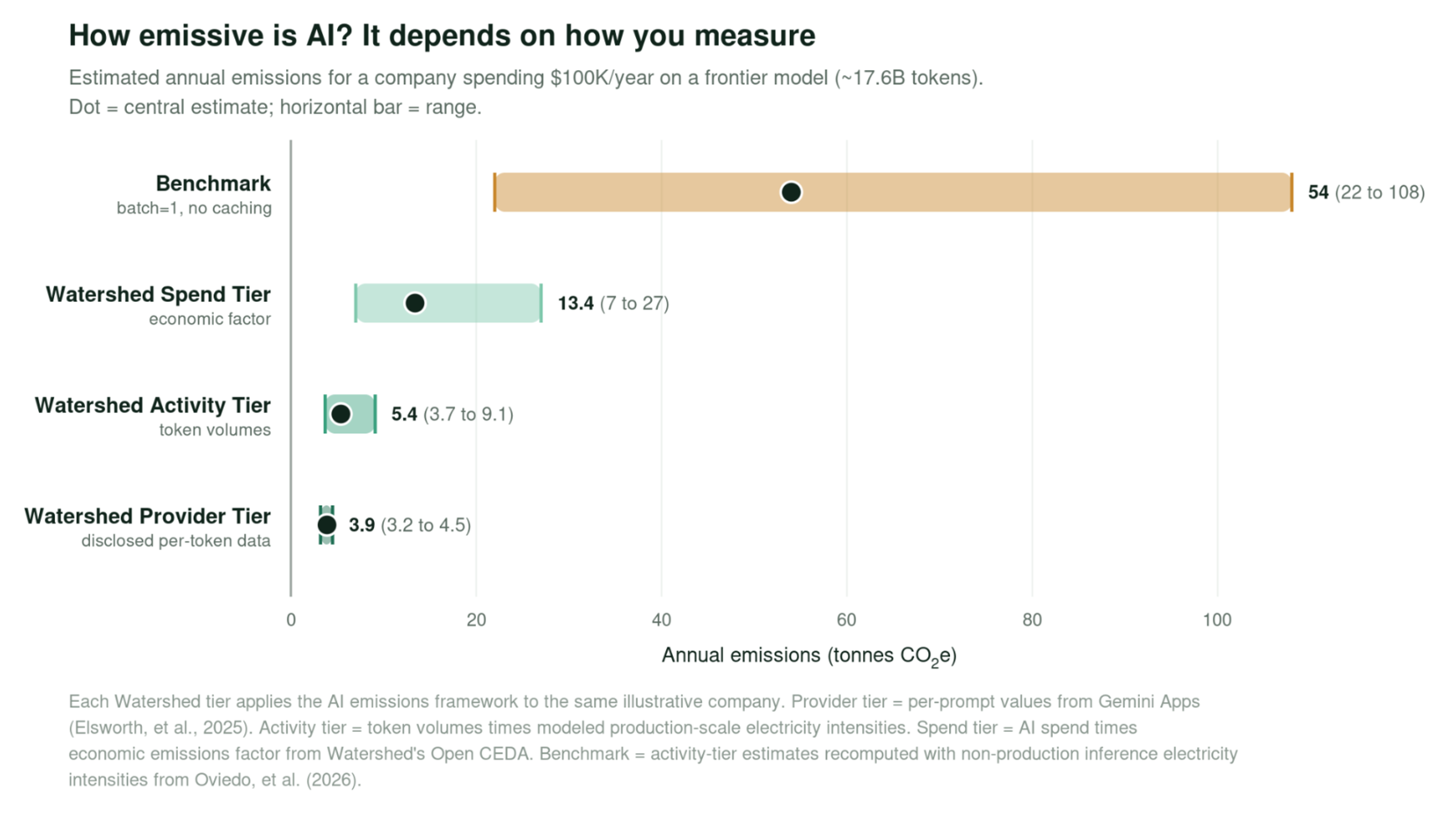
Better provider data can materially improve accuracy. When first-party emissions figures are available, AI’s emissions footprint has been lower than modeled estimates. The modeled benchmarks can overstate inference electricity use by 4 to 20 times, because they miss efficiency gains from deployment at scale. The framework proposes a standardized disclosure table to enable more precise corporate reporting.
Training emissions are the largest source of uncertainty, contributing between 32% and 56% of a model's total emissions footprint depending on assumptions about electricity consumption during training and total lifetime usage.
Tracking towards more accurate measurement
Accurate measurement ultimately depends on data from the companies that operate AI infrastructure. AI companies disclose data at varying levels: Google publishes per-prompt energy and emissions figures for Gemini; Meta discloses GPU hours, hardware type, and CO2e for each Llama release on both a location- and market-based basis; and AWS launched a Sustainability Console with service-level emissions data.
Our framework’s standardized disclosure format builds on this momentum. Where better data has become available, it shows AI infrastructure to be more efficient than modeled estimates assumed. Standardized disclosure gives providers a way to demonstrate that efficiency with auditable figures. As provider disclosure expands, companies will be able to compare AI emissions across vendors, factor emissions into procurement decisions, and track efficiency improvements year over year—turning accounting into an active management tool.
What companies can do now
The framework discusses practical levers companies can use today to address their AI emissions.
AI emissions depend on the electricity mix that powers the data center. Grid subregions alone vary by more than five-fold, and once clean power procurement is included, the effective range across regions and providers exceeds an order of magnitude. This makes the grid one of the most powerful levers for reducing AI’s footprint. Our framework reports electricity use alongside emissions, enabling companies to see the differences across grids and factor them into decision-making. As disclosure improves, transparency will allow markets to reward cleaner infrastructure.
The remaining levers for companies reduce the electricity consumed per task, and are worth pursuing where they fit existing engineering priorities:
- Choose the right model for the task. Reasoning models can use roughly 30 times more energy than smaller variants for equivalent queries. Routing simple requests to efficient models is the highest-impact lever most companies have.
- Choose the right region. US grid regions vary by more than five-fold in carbon intensity, so where a workload is served can matter as much as how it's run.
- Optimize prompts. Shorter, more targeted prompts reduce tokens, which drive both cost and emissions.
This is the starting line
This framework is a starting point, and it's designed to improve. We'll be incorporating new data sources into Watershed's platform as they become available. If you're measuring AI emissions or thinking about disclosure, we'd like to work with you.
Read the full white paper here.