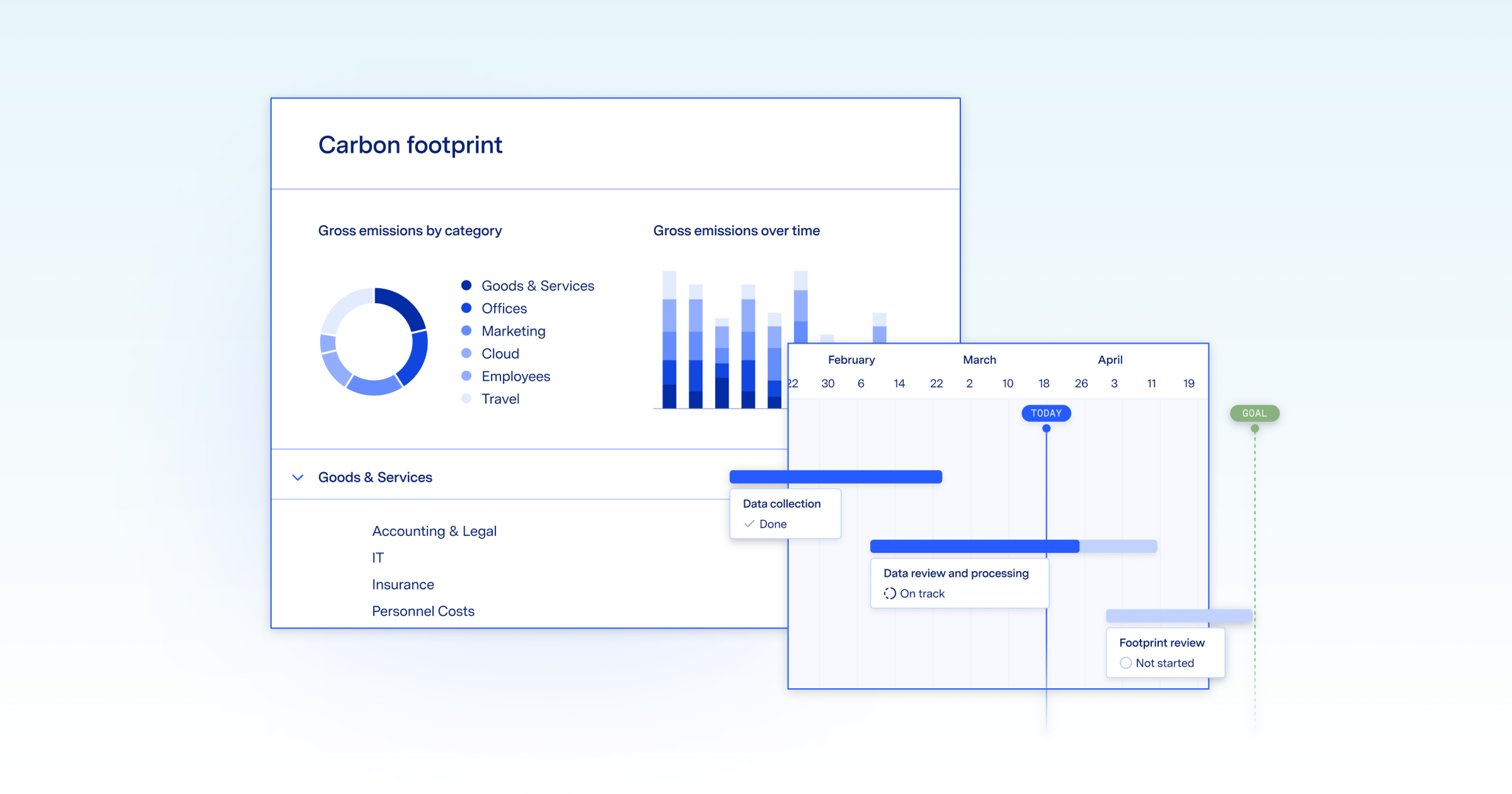
Sustainability reporting has entered a new era. Enterprises today face an unpredictable mix of regulatory shifts, customer demands, and internal pressure to deliver credible, decision-grade data — often across dozens of frameworks and stakeholders at once. In response, many teams are rethinking how sustainability reporting is built, governed, and scaled.
This article covers:
- The most common questions enterprise teams ask about sustainability reporting software in 2026.
- What separates durable platforms from short-term fixes.
- How Watershed helps organizations build reporting systems designed for change.
What is ESG reporting?
ESG reporting, also often referred to as sustainability reporting, is the structured process of measuring, managing, and disclosing a company’s environmental, social, and governance (ESG) performance. While often used interchangeably with ESG reporting, sustainability reporting is best understood as the operational system behind disclosures—covering:
- Environmental data such as scope 1–3 emissions and energy use.
- Social metrics like workforce practices, health and safety, and supply chain labor standards.
- Governance elements including oversight, controls, risk management, and accountability.
In 2026, sustainability reporting is no longer a static annual exercise. It is a continuous, audit-ready process that must adapt to shifting requirements without being rebuilt from scratch each time.
Why has sustainability reporting become so complex?
Enterprise sustainability teams are dealing with three converging pressures:
- Regulatory volatility: Global frameworks continue to evolve, pause, or shift in scope. Teams must stay prepared without over-optimizing for any single rule set.
- Exploding stakeholder demand: Beyond regulators, customers, investors, and partners increasingly request sustainability data—often in bespoke formats and timelines.
- Manual processes that don’t scale: Many organizations still rely on spreadsheets, disconnected tools, and ad-hoc workflows that create bottlenecks, errors, and audit risk.
The result: reporting consumes an outsized share of sustainability teams’ time—limiting their ability to focus on emissions reduction and strategy.
What is sustainability reporting software?
Sustainability reporting software is a centralized platform that enables organizations to collect, validate, manage, and disclose sustainability data at scale.
At an enterprise level, this software must do far more than store metrics. It must:
- Serve as a single source of truth across environmental, social, and governance data.
- Support multiple frameworks and reporting outputs from the same underlying data.
- Maintain audit trails, evidence, and governance controls.
- Adapt as requirements change—without rework.
In practice, sustainability reporting software functions much like a financial reporting system: structured, traceable, and built for scrutiny.
How do enterprises use sustainability reporting software?
A modern reporting workflow typically includes:
- Data integration: Connecting core systems such as ERP, HRIS, procurement, utilities, and travel platforms.
- Supplier and partner data collection: Engaging suppliers to support scope 3 emissions and social metrics.
- Data standardization and validation: Applying consistent calculation methods and quality checks across datasets.
- Framework mapping: Aligning the same data to different disclosure requirements without duplication.
- Reporting and review: Drafting disclosures with full transparency into sources, assumptions, and changes.
Without purpose-built software, these steps become manual, error-prone, and difficult to defend.
What makes sustainability reporting software “enterprise-grade”?
Not all sustainability tools are designed for enterprise complexity. In 2026, leading platforms share a few defining characteristics:
- A strong data foundation: Measurement and reporting must be built on the same system. AI and automation are only reliable when grounded in accurate, structured data.
- Adaptability by design: Reporting tools must handle new frameworks, customer requests, and internal needs without rigid templates or reimplementation.
- Defensible outputs: Every number, narrative, and AI-assisted suggestion must be explainable—with clear sources, approvals, and accountability.
Enterprise teams are increasingly prioritizing platforms that are resilient to change, not optimized for a single moment in time.
Can AI help with sustainability reporting?
AI can support organizations who want to build sustainability reporting—but only when implemented carefully. Many organizations are experimenting with AI to reduce the burden of reporting. The risk is shifting effort from writing to reviewing unreliable outputs.
Effective sustainability AI requires:
- A clean, consistent underlying data layer.
- Embedded subject-matter expertise, not generic language models.
- Guardrails that surface uncertainty and prioritize human review.
- Full transparency into how outputs are generated.
When designed correctly, AI can accelerate reporting while reducing compliance risk.
How is Watershed approaching sustainability reporting in 2026?
Watershed is built to help enterprises design sustainability reporting systems that remain credible under scrutiny and flexible under change.
The platform combines three core principles:
- A unified data foundation: Watershed brings measurement and reporting together, ensuring that AI-assisted outputs are grounded in the same audit-grade data used for disclosures.
- A flexible reporting layer: Watershed’s flexible report builder allows teams to create and update any report—regulatory, customer, or internal—using shared data that updates dynamically.
- A defensible review system: Every data point and narrative includes:
- Source transparency.
- Change history and approvals.
- Clear separation between human and AI actions.
This makes reporting faster while preserving trust with auditors, regulators, and stakeholders.
Who is sustainability reporting software like Watershed best for?
Watershed is designed for organizations with:
- Complex operations and global supply chains.
- Multiple, overlapping reporting requirements.
- A need for audit-ready, investor-grade data.
- Sustainability teams that must balance compliance with real climate action.
For these organizations, sustainability reporting is infrastructure—not a side project.
What is the ROI of sustainability reporting software?
While compliance is often the initial driver, the return is broader:
- Lower reporting and audit costs.
- Faster response to customer and investor requests.
- Reduced risk from inconsistent or untraceable data.
- More time and budget directed toward decarbonization and strategy.
When sustainability reporting moves off spreadsheets and into a unified system, both operational efficiency and decision quality improve.
Final thought: Build for change, not certainty
The future of sustainability reporting will continue to shift—shaped by regulation, markets, and technology. The most resilient organizations are not betting on perfect clarity. They are investing in systems that can adapt, explain themselves, and scale with confidence. In 2026, sustainability reporting software isn’t just about keeping up. It’s about building a foundation strong enough to move faster when opportunity appears.