For most companies buying or producing physical goods, the majority of emissions lie upstream in the materials that go into their own products. As the greatest driver of emissions, this category—also known as scope 3.1—is therefore often the greatest decarbonization opportunity.
To drive these emissions down, the historic playbook involved casting a wide net. Companies would survey suppliers to request product carbon footprints (PCFs) of the purchased goods, and use those to understand which buying options are lower-carbon. Unfortunately, few—if any—companies have found success with that playbook.
As we learned through working with customers on our Supply Chain product, the reality is that chasing suppliers for data can consume months of sustainability team time. Even when teams could get PCFs from suppliers, the data was outdated or couldn't be trusted to inform business decisions.
Last year, Watershed launched our AI-powered Product Footprints tool to support another approach companies were moving towards: making PCFs on behalf of suppliers.
Instead of asking unprepared suppliers to make PCFs from scratch, leading programs are using sustainability AI to generate PCFs on behalf of suppliers. Like manual PCFs, these can incorporate any available data, like product specs or bills of materials—but at a fraction of the cost and time investment.
With an AI-generated PCF in hand, supplier engagement then shifts toward more valuable activities like validating the most critical data and collaborating with suppliers on plans for how to decarbonize.
Where the old model of surveying suppliers for PCFs failed
The historic model was inefficient. Response rates for PCF surveys were typically well below 50%—often because suppliers simply do not have PCFs to share. One Watershed customer, a major global retailer, spent months of team time chasing suppliers for responses to PCF surveys. Ultimately, they could not collect enough responses to inform decisions, and those months were wasted.
The results from the historic model were often unhelpful. When suppliers did share PCFs, there were three major pitfalls.
- PCFs weren't apples-to-apples comparable. Even two different companies with teams of expert LCA researchers making a PCF or LCA of the same product would take different, valid approaches to system boundaries, data tiers, secondary database selections. For example, one may have used ecoinvent as a data source while the other used howgood, or they could have used different allocation method choices. As a result: companies surveying suppliers for PCFs couldn't use them for comparison, which is—for some—the whole point.
- PCFs were delivered as "flat" numbers that can't be decomposed to reveal all assumptions and underlying drivers of emissions. Without a view into the materials, energy, processes, and geographies that most drive emissions, it's impossible for companies to identify decarbonization opportunities across suppliers (e.g., "incentivize suppliers to leverage lower temperatures during a given process") to build strategy around.
- Companies couldn't get credit for where suppliers were taking action. A Watershed customer in the global food industry works with suppliers that only use deforestation-free palm oil. The company historically struggled to leverage that information or see that action reflected in their corporate footprint because these suppliers either didn't have PCFs available, had PCFs that didn't account for that detail, or had PCFs that did account for the detail but, because of other methodological choices, weren't comparable to other suppliers' PCFs.
Suppliers don't have a way of incorporating actions into PCFs, and so companies using traditional supplier engagement approaches don't have a way of applying suppliers' actions in their own corporate footprints. Without closing the loop to compare suppliers real actions, buyers can't quantify suppliers' progress or justify lower-carbon procurement decisions.
While standards and data exchanges like the Partnership for Carbon Transparency (PACT) are valuable tools for defining how PCFs are exchanged, they don't solve the data comparability issue given they don't define methodological consistency.
The new path forward
In the past few years, some companies tried to get around the comparability and black-box problems by skipping suppliers, and instead making PCFs of anything they purchased on behalf of suppliers. This led to data that could actually drive decisions and insight. The problem, though, was that building PCFs was a time-consuming craft, and companies could only do this for a few key purchased goods.
Now, sustainability AI has unlocked this approach at scale-and, with unprecedented granularity and transparency.
Companies are building PCFs at scale with Watershed Product Footprints, and in moments. These PCFs enable companies to:
- Compare between purchase options: Build PCFs for anything you purchase, or are considering purchasing, to pinpoint nuanced differences between options and suppliers to drive decision-making.
- Decompose the full supply chain behind the PCF: Watershed PCFs are backed by full, decomposable production graphs that show all input materials and processes that went into producing the good. And Watershed's advanced AI model can easily understand and research likely inputs to construct the supply chain, even where the material name is vague to a human, like M4x6ss (a stainless steel screw) or SOJA EM GRAOS GRANEL (Brazilian soybeans).
- Pinpoint emissions hotspots in one good, or across a portfolio: Advanced data analysis tooling makes it possible to understand exactly which emissions sources drive emissions, helping you craft supplier engagement and decarbonization strategies.
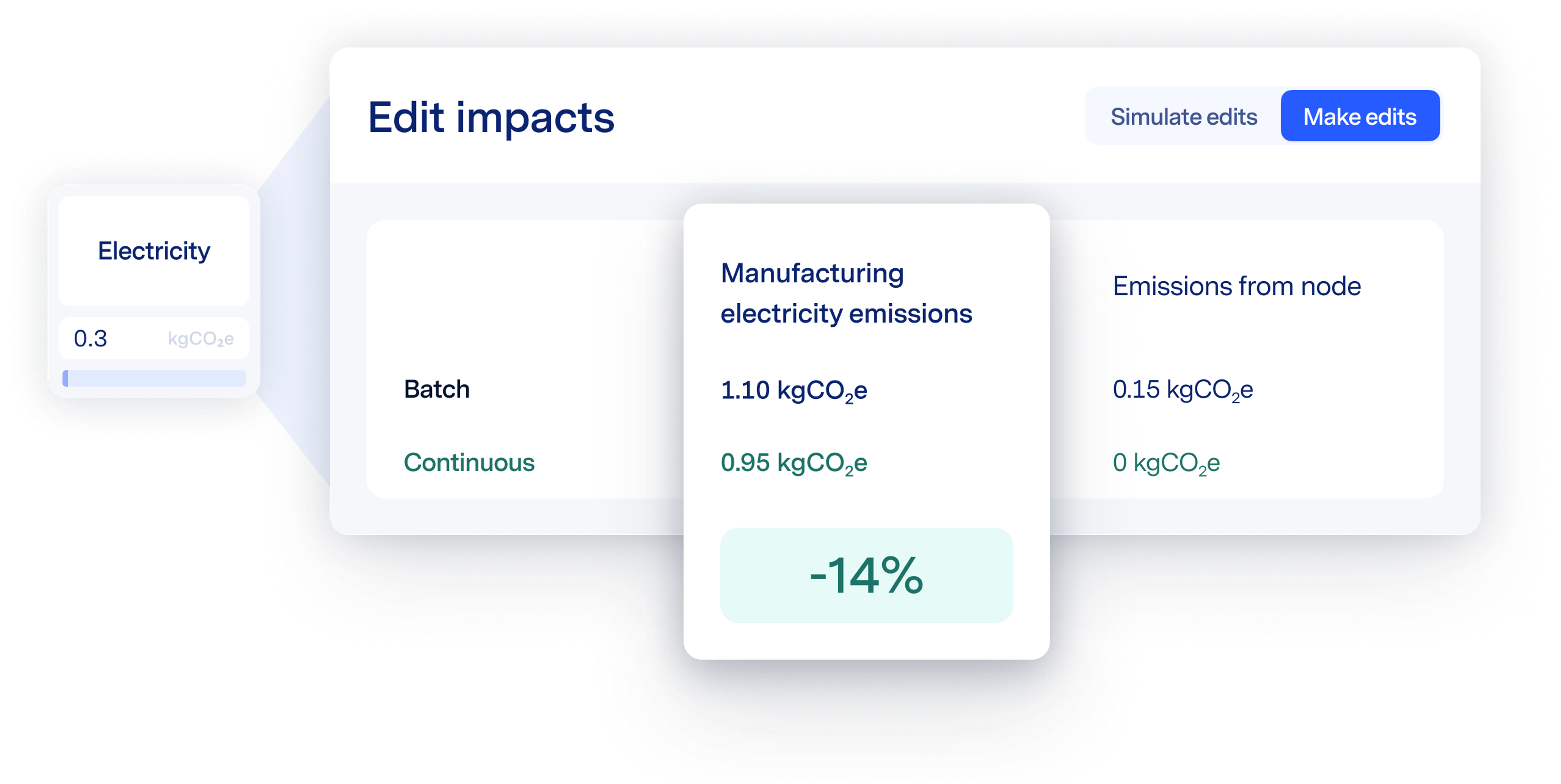
- Keep PCFs updated by editing with the latest data available: If your supplier sends an updated BOM, for instance, inject that data into a new version of the PCF to reflect the change. Do the same if a supplier lets you know they've moved the production facility to clean power, are transporting the good with sea shipping, or any other data you might receive.
"With Product Footprints, we can account for details like use of recycled and bio-based materials, supplier-specific energy use for a specific manufacturing process, and which suppliers are using renewable energy," explained Nadia Carroll, Specialized's Product and Engineering Sustainability Lead.
This process is saving teams months of time, and gaining them leverage in supplier conversations. Sustainability teams can better validate which existing supplier PCFs are credible, and which don't stand up to scrutiny. Sustainability teams can also help procurement understand data behind what they're purchasing, like what a supplier might be paying in European ETS fees to get a better sense of which costs are being passed on.
"There is so much data out there—you could read a 200-page sustainability report from a supplier and try to pull out insights," noted Natalie Watson, Vita's Group Director of Sustainability. "But Watershed's AI has unlocked the ability of understanding that data at scale and turning it into practical insights."
A hybrid approach that blends AI generated PCFs with supplier engagement follow up is a good place to start. The most common approach we've seen is:
- Use a spend-based database, like CEDA, for purchased services. Spend based databases are good for scaled data.
- Use an activity-based database, like ecoinvent, for the long tail of lower-emissions and/or lower-volume purchased goods.
- Use sustainability AI to make PCFs on behalf of supplier for higher-emissions or higher-volume purchased goods. Make sure you're using AI grounded in sustainability intelligence and not a general purpose AI.
- Optional: For goods from trusted suppliers with PCFs: use supplier-provided PCF and pull into corporate footprint.
Regardless of the approach, when making PCFs in Watershed, companies are armed to go to suppliers with a strong baseline understanding of where emissions sit, and what the expected impact of specific actions would be to help suppliers move towards action to drive down 3.1 emissions.
Instead of asking "what is the PCF of this good" and not receiving a response, Watershed customers have found that asking suppliers questions that actually matter more for building a PCF, like where something is manufactured or what the composition / BOM is-which is data suppliers actually have.
When suppliers do make changes that reduce emissions, companies can immediately reflect those in Watershed.
"We had intuition on hotspots, but couldn't validate the impact of swapping a material in our product design," explained Emily Foster, Director of Environmental and Social Impact.
The strongest supplier engagement programs are shifting from collecting flat PCFs to building actionable, apples-to-apples footprints that can guide decisions. AI makes that shift practical at scale, while giving teams more leverage and clarity in supplier conversations. If you are planning a supplier engagement program, start by designing for action and comparability, not survey response rates—and focus the rest of your time on meaningful action.
Download: supplier engagement RFP line items
To support teams planning a supplier engagement program (and to avoid RFPs that implicitly optimize for survey chasing), Watershed compiled a set of supplier engagement RFP line items.
Leverage this RFP template to find a solution provider that can accelerate your 3.1 work, all while streamlining the connection between PCFs and your corporate footprint, and preparing PCFs for any of your customers who do request them.