December 2025 brought two significant updates in the world of European sustainability reporting.
- The European Commission, Parliament, and Council reached an agreement on the year-long Omnibus discussions to simplify sustainability reporting under the CSRD and CSDDD.
- EFRAG–the technical body advising the Commission on the standards on which companies will report–formally submitted its recommendations on the simplified European Sustainability Reporting Standards (ESRS) to the European Commission for consideration.
Top 3 things to know:
- The Omnibus agreement is expected to be officially published in early 2026. This starts the process for member state transposition.
- The European Commission will conduct a public consultation on the draft ESRS in Spring 2026.
- The Simplified ESRS are expected to be formally adopted by the European Commission in mid-2026. These do not require member state transposition.
Omnibus updates
Background
In February 2025, the European Commission proposed a package of 10 reform initiatives (the “Omnibus”) to boost European competitiveness. The first of these aimed to streamline a collection of EU Green Deal regulations—the CSRD, the CSDDD, CBAM, and the EU Taxonomy—in an effort to reduce the regulatory burden on businesses working toward sustainability goals.
What happened
In December 2025, the three major European legislative bodies (the European Commission, Parliament, and Council) came to a provisional agreement on the proposed reforms. The Parliament formally approved this agreement soon after. Council approval (a formality) and official publication of the revised CSRD (starting the clock for member state transposition) is expected in early 2026.
The most significant change in the Omnibus agreement is substantially higher reporting thresholds, with approximately 5,000 companies captured in scope for CSRD.
New thresholds
Other significant updates include:
CSRD
- Removal of reasonable assurance requirements. Only limited assurance is required, starting with FY2027 data (in 2028).
- Financial holding undertakings exemption. Financial holding companies not involved in the management of their subsidiaries are exempt.
- Parent company exemption. Large subsidiaries with transferable securities traded in the EU are exempt from reporting if their parent company reports.
- Value chain cap exemption. Reporting companies are prohibited from requesting companies with fewer than 1,000 employees sustainability data exceeding that prescribed in the voluntary ESRS (pending Commission adoption).
- M&A exemption. Companies may exclude newly acquired entities from their sustainability statement until the next reporting period, and may exclude entities sold or disposed during a financial year from that year's statement.
- Provision for scope reassessment. The Commission will revisit thresholds and exemptions for CSRD in-scope companies in 2029.
Note: EU member states may impose national reporting requirements that are more stringent than those required by the CSRD.
CSDDD
- Removal of mandatory climate transition plans. Companies are no longer required to adopt and implement a climate transition plan with targets
- Penalties for non-compliance reduced to 3% of global turnover.
- Removal of EU-wide civil liability. Member states may now individually decide whether to impose civil liability for companies whose failure to meet due diligence obligations leads to damage. Previously, CSDDD required harmonized EU-wide civil liability.
Simplified ESRS
Background
The European Sustainability Reporting Standards are the technical standards that describe what a company’s CSRD sustainability statements must include. The original ESRS were criticized for having too many datapoints, unclear definitions, and repetition. In response, the European Commission requested EFRAG to simplify the ESRS.
What happened
In December 2025, EFRAG shared its recommendation for simplifying the ESRS with the Commission. These simplified ESRS are still in draft status - the European Commission must formally adopt them before they are considered finalized.
Key changes:
- Simplified double materiality assessment. Companies are now explicitly expected to use available information without incurring “undue cost or effort”, and are not required to conduct stakeholder consultations.
- 60%+ of original data points removed. Mostly qualitative, with a view to reducing redundancies. Additionally, reporting companies can cross-reference other sections of the sustainability statement where applicable, instead of having to restate the same information multiple times.
- Most quantitative data points remain. However, estimates are now considered as good as actuals for value chain data, easing data collection burden on reporting companies.
- Many data points clarified. Interoperability is called out as a goal of the simplified ESRS, and many data points are now intentionally defined to be compatible with ISSB requirements.
- A very small number of data points have been added, such as % of waste with unknown final destination.
Who reports when, and on what?
To avoid companies reporting both the original and simplified ESRS, the European Commission postponed the reporting deadlines for most in-scope companies (the ‘Stop-the-Clock’ directive). The below graphic describes what ESRS standards companies must report and when, accounting for Stop-the-Clock.
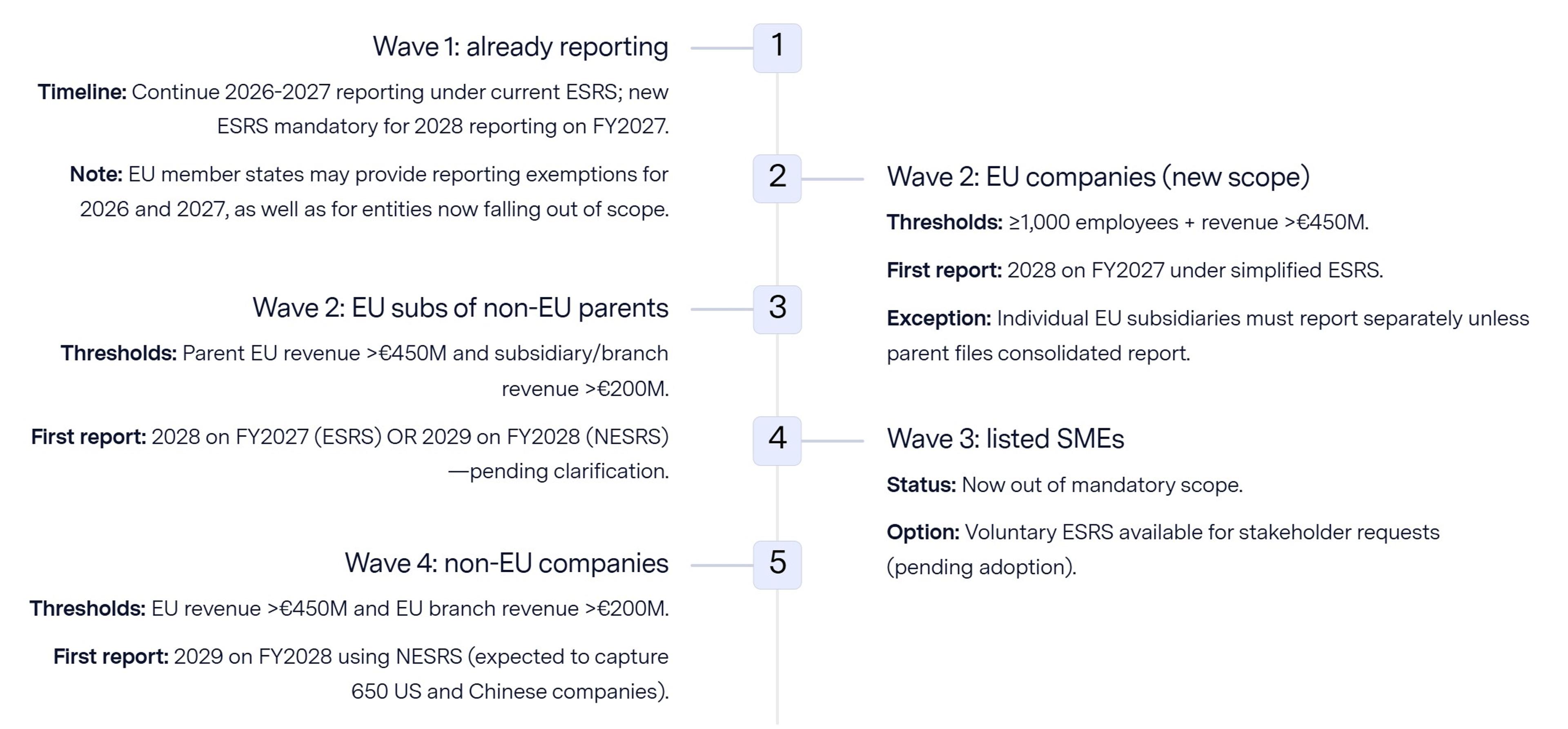
Note: Under the original thresholds, EU branches of non-EU companies would have had the option to report using a set of reduced ESRS called the Non-EU ESRS (NESRS). NESRS drafting has been paused while EFRAG works on the Simplified ESRS. It is expected to resume in 2027.
What’s next?
What should companies do now?
Immediate-term
- Re-assess whether you meet the new thresholds or exemption criteria.
- Continue work on GHG inventories and climate risk assessments. Multiple mandatory and voluntary reporting programs continue to require these.
Medium-term
- Review the draft ESRS to get a sense of what metrics are still required. Engage with company stakeholders to assess status of current data systems
- Set up internal controls for sustainability data
- Monitor member state transposition of CSRD
Long-term
- Set up procurement systems/value chain outreach programs to account for value chain exemption