

California has some of the world's broadest emissions disclosure requirements. This guide explains who the laws apply to, what’s due now, and where ongoing legal cases stand. It then covers what changes in 2027 and how to prepare. It also shows how California’s requirements overlap with other climate reporting rules, so the work you do here can serve more than one purpose.
Key takeaways
- Scope 1 and 2 reports are due annually by November 10.
- Limited assurance for scope 1 and 2 emissions is expected to start in 2027.
- SB 261 and scope 3 enforcement is still paused while a California district court resolves an appeal.
- Both laws apply to US-formed entities that do business in California and earn more than $1 billion (SB 253) or $500 million (SB 261) in global revenue. That includes parent companies headquartered in other states or countries.
Over 1,500 large companies submitted their first SB 253 reports in 2026. In 2027, SB 253 is expected to enforce stricter methodology requirements and make limited assurance on scope 1 and 2 mandatory.
What’s the difference between SB 253 (a.k.a. CCDAA), SB 261, and SB 219?
Much of the confusion about California’s climate rules comes down to names. There are two laws, one set of amendments, and one regulator, and people often use several names for the same thing.
CARB, the California Air Resources Board, is the state agency that writes the regulations and enforces both laws.
- SB 253, the Climate Corporate Data Accountability Act (CCDAA), requires large companies to disclose their greenhouse gas (GHG) emissions every year. It was published in 2023.
- SB 261, the Climate-Related Financial Risk Act, covers a larger group of companies. They must report every two years on how climate change could affect their business. It was also published in 2023.
- SB 219, signed in September 2024, amended both laws. It changed how they’re carried out. It didn’t merge them or add a third reporting requirement.
In 2025, the US Chamber of Commerce filed a case asking a federal appeals court (the Ninth Circuit) to pause enforcement of both SB 253 and SB 261. On November 9 2026, the Ninth Circuit ruled scope 1 and 2 enforcement could go ahead, but stopped enforcement of scope 3 disclosure and SB 261. The case is now with a district court to determine the future of these laws, though in practice CARB will not be enforcing these requirements. Many companies will continue working on these for other regulations or investor requests, but CARB will likely pause work on these until any further changes.
For a closer look at SB 253, read our guide to SB 253 requirements.
Do California climate disclosure laws apply to companies outside California?
Yes. Where a company is headquartered doesn’t decide whether it’s covered. Both laws apply to any entity that passes three tests, and many companies based in New York, Texas, or overseas pass all three.
Test 1: How the entity was formed. It must be organized under US law as a corporation, partnership, limited liability company, or other business entity. Note: the entity can be a subsidiary of a non-US parent and still be in-scope.
Test 2: Revenue. The entity’s global gross receipts must have been above the threshold in each of the two prior fiscal years. The threshold is $1 billion for SB 253 and $500 million for SB 261. Revenue earned outside California counts toward the total, so a company that makes most of its sales in other states can still qualify.
Test 3: Doing business in California. The laws borrow this definition from the state’s Franchise Tax Board. An entity does business in California if it’s organized or commercially domiciled in the state, or if its California sales are over $757,070 or 25% of its total sales.
The sales threshold is what brings in so many out-of-state companies. A business with $2 billion in global revenue needs only a small share of California sales to cross it.
To find out if your company is in scope, use our California disclosures compliance checker. For full details, refer to CARB’s official program page.
How are parent and subsidiary companies treated?
Each entity is assessed on its own, which matters for groups with complex structures. A parent company controls a subsidiary when it owns more than 50% of it.
A parent that qualifies can file one consolidated report covering its subsidiaries, so each one doesn’t have to file separately. The report must name every subsidiary that meets the thresholds on its own, and each of those subsidiaries still pays its own CARB fee. Consolidating means fewer reports to file, but the fees stay the same.
Foreign parents work the same way. A parent formed outside the US may file a consolidated report for its US subsidiaries if it does business in California. If it doesn’t, each qualifying US subsidiary files its own report.
Which entities are exempt?
The laws exclude a short list of entity types:
- Nonprofits.
- Government entities.
- Entities whose only connection to California is employees working remotely from the state.
- Wholesale electricity entities such as the California Independent System Operator.
- Insurance companies, with conditions.
The insurance exemption has changed the most. It started in SB 261, and CARB extended it to SB 253 in February 2026. In July 2026, CARB proposed narrowing it. Under the proposal, an insurer could rely on its California Department of Insurance report only if that report includes everything SB 253 requires. If it doesn’t, the insurer would need to file a separate SB 253 disclosure. Insurers that assumed they were fully exempt should check their current reporting against SB 253’s requirements.
Can you rely on CARB’s preliminary list of covered companies?
In September 2025, CARB published a list of companies it thought was in-scope for SB 253. The list has known omissions, and CARB has said it isn’t meant to decide coverage. A company that doesn’t appear on it may still be covered. Run your own assessment against the three tests above, and document your reasoning in case you need it later.
This list was published to estimate how many companies would need pay fees. It counted about 2,596 companies under SB 253 and 4,100 under SB 261.
For help scoping your reporting entities, read the California compliance list. Collecting data across a group of subsidiaries is covered in the readiness section below.
What are the current requirements, deadlines, and fees?
What do you report for SB 253 in 2026?
SB 253 reports cover scope 1 and 2 emissions, calculated using the GHG Protocol. Scope 1 covers direct emissions from sources a company owns or controls. Scope 2 covers emissions from the electricity, heat, and steam it buys. Scope 3 and assurance aren’t required this year.
Companies report on one of two fiscal-years. If your fiscal year ended before February 1, 2026, report data for your 2025 – 26 fiscal year. Companies whose fiscal years ended after February 1, 2026 may choose either their 2024 – 25 or their 2025 – 26 fiscal year.
CARB has built in some flexibility for the first year of reporting. It said it would not penalize incomplete first reports from companies acting in good faith. This relief applied to the first reporting cycle only. From 2027, CARB expects a full scope 1 and 2 inventory that follows prescriptive methodology requirements and can withstand limited assurance.
What goes into an SB 261 report?
Reminder: SB 261 enforcement is paused. We recommend companies continue to prepare climate risk assessments as required by SB 261 as these can be resued for the other regulations globally.
SB 261 asks a different question than SB 253. Instead of measuring emissions, it asks companies to describe their climate-related financial risks and what they’re doing to manage them. Reports are due every two years.
Companies can follow the Task Force on Climate-related Financial Disclosures (TCFD) recommendations, IFRS S2, or an equivalent framework from a government or stock exchange. Whichever they choose, the report covers four areas: governance, strategy, risk management, and metrics and targets. It must also name the framework used and explain anything left out. This is often called "comply or explain."
When does assurance start?
Assurance is where SB 253’s requirements tighten fastest. Limited assurance checks your work and confirms you followed the processes you said you have. Reasonable assurance is closer to a financial audit and takes considerably more work.
The readiness section below covers which assurance standards CARB accepts and how to prepare for an engagement.
Key milestones
How do you submit?
Companies can file through CARB’s voluntary intake platform or by emailing climatedisclosure@arb.ca.gov. CARB’s 2026 SB 253 reporting guidance explains what each report should include, and the agency offers an optional template. CARB sends fee invoices to the contact information you provide when you submit, so make sure that information is current and reaches someone who can act on it.
What are the fees and penalties?
CARB’s February 2026 regulation set a flat annual fee for each covered entity:
These amounts are estimates. They’re based on a total program cost of about $13.9 million divided across the expected number of covered companies, so they may change once CARB has a final count. CARB will invoice companies that submitted reports in December 2026, so companies will have a more precise sense of fee amounts by then.
Penalties are capped at $500,000 per year under SB 253 and $50,000 per year under SB 261. When setting a penalty, CARB considers whether a company made a good-faith effort and its compliance history.
SB 253 is moving ahead on schedule. SB 261 is on hold, and the courts will decide when it restarts.
What’s the latest on the SB 261 injunction and court ruling?
SB 261 enforcement remains paused while the the district court reviews the Ninth Circuit's ruling.
Should you still prepare an SB 261 report?
Yes. Preparing now is also low-risk: many companies already report under TCFD or IFRS S2, so much of the work carries over to other reports whatever the court decides.
For more on the case, read our Ninth Circuit update.
What changes in 2027?
2027 is when SB 253 takes more of its full shape. Assurance becomes mandatory and methodology requirements begin to kick in.
How should you get ready for 2027?
The regulations tell you what to report. Whether you can produce a report that holds up under assurance depends on how you organize your data, your teams, and your records internally. Companies that start now have time for a practice run before anything counts.
Who should own the reporting process?
Climate reporting draws on data from across the business, but it needs one accountable owner. That person, often the sustainability or ESG lead, coordinates contributors, sets deadlines, and signs off on the final numbers. Without a clear owner, data requests stall and decisions about methods and boundaries get made inconsistently.
What data do you need for each scope?
Each scope, and each scope 3 category, draws on different source systems. Mapping them early shows where data already exists and where you’ll need estimates.
For groups with several subsidiaries, consistency matters as much as completeness. Collect data in the same format from each entity, and decide early who signs off locally. That makes consolidation easier and gives assurance providers one consistent view.
How should you set boundaries and record decisions?
Your organizational boundary decides which entities and operations your inventory includes. Set it once and keep it consistent from year to year. In a recent Watershed webinar, Ulysses Smith, Senior Advisor at the law firm Debevoise, said inconsistent boundary decisions are a common way companies create problems in later reporting years.
Alongside the boundary, keep a record of:
- The emission factors you used, with their source and version.
- Your key assumptions.
- How you handled each data gap.
These records turn a spreadsheet into an inventory you can defend. They make your 2027 baseline credible and your assurance engagement faster.
How should you prepare for assurance?
CARB accepts five assurance standards:
- ISSA 5000 (IAASB).
- AA1000.
- ISO 14064-3.
- AICPA AT-C 205 and 210.
- ISAE 3000 and 3410.
Providers must be independent and experienced, and CARB may review their work papers. Demand for qualified providers is rising quickly, so choose a provider and a standard well before your first assured filing.
Assurance providers typically review:
- How you defined your organizational boundary.
- Where your emission factors come from and how current they are.
- How you documented your calculation methods.
- What evidence you have of internal review.
- Whether there’s a clear audit trail from raw data to each reported number.
A practice engagement, or dry run, before limited assurance starts is one of the best investments you can make. It shows where your records fall short while there’s still time to fix them.
“The objective is reasonable, defensible inventory. It’s not perfect information about every transaction in the supply chain.”
Ulysses Smith, ESG Senior Adviser, Debevoise & Plimpton LLP
How should you handle data gaps?
Every first-year inventory has gaps, especially in scope 3. The GHG Protocol accepts spend-based and industry-average methods where primary data isn’t available, and most companies rely on them heavily at first.
What matters is how you handle the gaps. For each one, record what data you have, what’s missing and why, and how you plan to close the gap by the next cycle. Raising a gap yourself is far better than having an assurance provider find it. It also fits both CARB’s good-faith approach and the scope 3 safe harbor.
2027 readiness checklist
- Confirm your 2026 scope 1 and 2 filing is complete.
- Assess all 15 scope 3 categories, and whether you need to report them for other regulations.
- Choose calculation methods and record your sources.
- Book an assurance provider early, since capacity is limited.
- Map what you already report for CSRD, ISSB, or CDP.
- Assign a data owner for each source.
For a step-by-step plan, read our guide on how to prepare for SB 253 and SB 261.
Item five on that list deserves more attention. California is rarely the only climate reporting requirement a large company faces, and much of the work overlaps.
How do SB 253 and SB 261 relate to other climate reporting rules?
Large companies often report under several regimes at once: California’s laws, the EU’s Corporate Sustainability Reporting Directive (CSRD), ISSB-based rules in other countries, CDP questionnaires, and requests from investors and customers. Each has its own format and timeline, but most share a common core. Emissions, climate-related risks, transition plans, and assurance appear in nearly all of them. Companies that build that core once can reuse much of it across regulations.
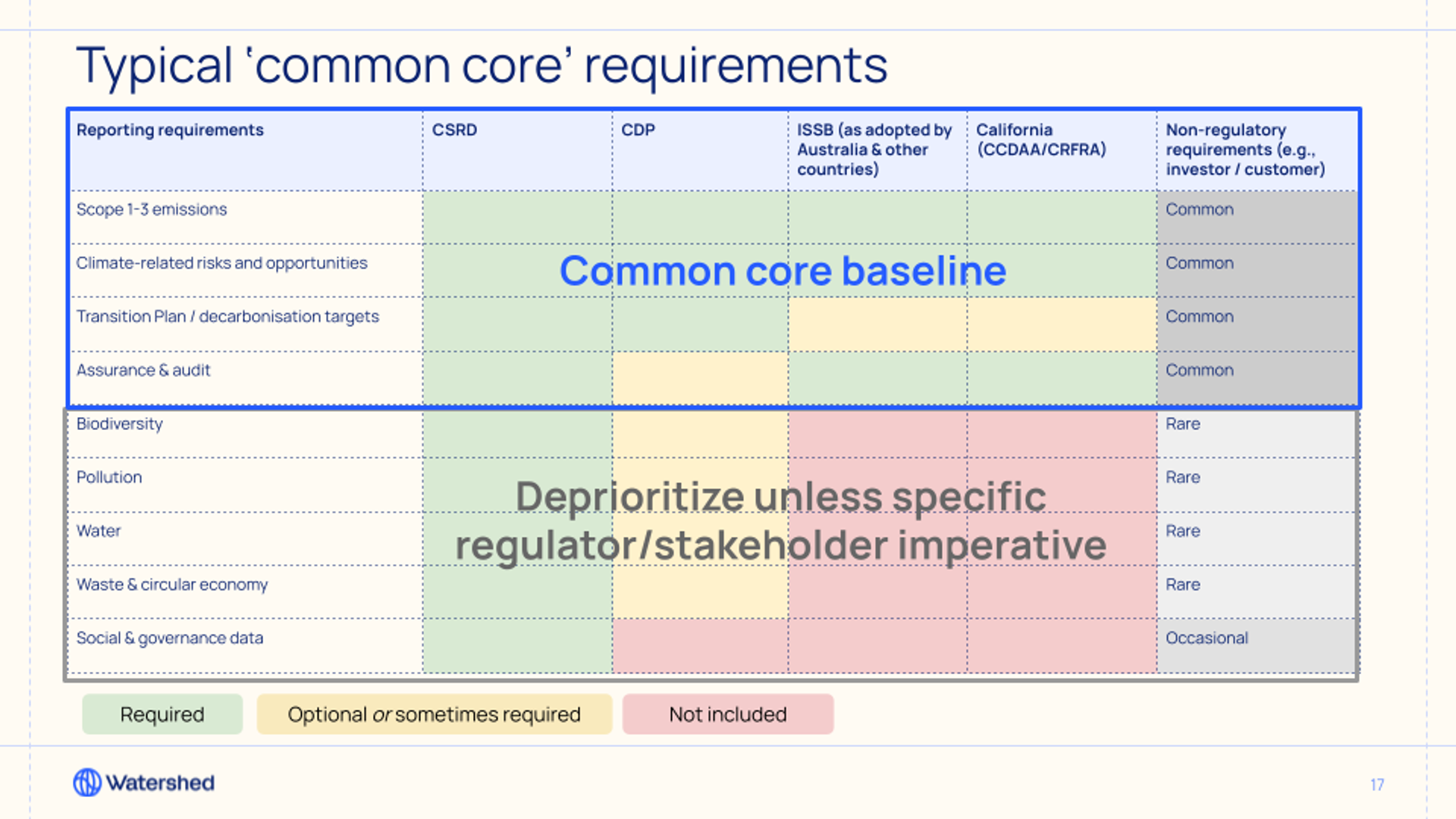
The top four rows are the common core. They appear in almost every regulation and investor request, so they’re where reporting effort pays off most. The bottom five, covering biodiversity, pollution, water, waste, and social data, matter mainly for CSRD and specific stakeholders. Unless a regulator or major customer asks for them, they can wait until the core is solid.
Are other US states passing similar laws?
At the state level, US climate disclosure is still a patchwork. New York lawmakers considered a bill modeled on SB 253, but it didn’t pass in the 2026 session and may be reintroduced. For details, read our New York climate disclosure guide. Lawmakers in New Jersey and Illinois have introduced similar bills, and none has become law.
At the federal level, the SEC rescinded its climate disclosure rule in 2026. For now, California is the main source of mandatory climate disclosure in the US.
Most state proposals copy California’s $1 billion threshold and its GHG Protocol approach. If more states pass laws, an inventory built for California should carry over with little extra work.
How does California compare with international rules?
Outside the US, mandatory disclosure keeps expanding. In the EU, companies in the second wave of CSRD are now preparing to report. ISSB-based rules are spreading across Asia-Pacific, with Singapore, South Korea, and Japan moving toward requirements for most listed companies by 2028.
California’s emissions requirements line up closely with both. All three use the GHG Protocol, all three cover scope 1 through 3, and all three are moving toward assurance. For multinationals, one well-built emissions inventory can support filings in each jurisdiction.
To track upcoming deadlines across jurisdictions, use Watershed’s climate policy calendar.
Frequently asked questions
Yes. OAL approved CARB’s regulation in October 2026, which confirmed November 10 as the deadline for the first SB 253 reports.
What should you do next?
If you’re planning your next steps, these resources go deeper:
- Read our guide on how to prepare for SB 253 and SB 261.
- Compare the best solutions for SB 253 and SB 261 reporting.
- Explore Watershed for California disclosures or request a demo.