Today, we’re expanding the Watershed platform to cover any ESG metric, for any ESG report, with AI-accelerated report drafting and assistance. Our goal is to help sustainability teams spend less time on reporting minutiae and more time on impact—and to ensure they’re ready for whatever comes next.
Watershed was designed to help sustainability teams solve the complex problem of granular, highly accurate emissions reporting. Over the years, we’ve expanded into waste, water, land-use change, and social and governance metrics. But if the last year has taught us anything, it’s that change is the only constant.
About a year ago, the EU Omnibus arrived and redirected months of CSRD (Corporate Sustainability Reporting Directive) preparation for some companies. Then, over the course of the last year, SB 261, SB 253, ASRS (Australian sustainability reporting standards), and UK SRS (UK Sustainability Reporting Standards) have all come sharply into focus. At the same time, companies are fielding increasing requests for sustainability data from their own clients and partners—and sustainability teams are more resource-constrained than they've ever been.
This all adds up to a new mandate for sustainability teams to modernize. Today's manual, fragmented approach to ESG reporting won't work in the face of the growing demands. Sustainability teams need a smarter, faster way to manage ESG data.
Starting today, you can streamline ESG reporting with three new capabilities in Watershed:
- Manage all your ESG data: Watershed can now manage and measure all ESG data—including custom data and metrics—in one audit-ready place.
- Produce any ESG report: A new, flexible report builder adapts to fit any reporting requirement or format.
- Spot gaps and improve reports with AI: Watershed AI now goes beyond accelerated drafting to serve as a conversational advisor within the reporting experience. Ask it to compare your report against peers, surface gaps to address, and review your report as an auditor would.
Together, these capabilities bring new speed and efficiency to resource-constrained sustainability and ESG teams. With purpose-built, transparent AI, you can spend less time on reporting and more time on impact.
A more agile approach to ESG reporting
Consolidate all ESG data into one auditable platform
According to research from Wolters Kluwer, 60% of finance leaders say their teams are struggling with fragmented ESG data. By consolidating all of ESG into one auditable platform—including any custom data types and metrics your reporting requires—you greatly reduce risk of inaccuracy and cut down on audit time. One customer from the health care industry told us, "We did the audit from within Watershed last year, and knocked it down from four months to two months." Now you can extend that same efficiency to ESG data management and reports.
Measure once and report everywhere
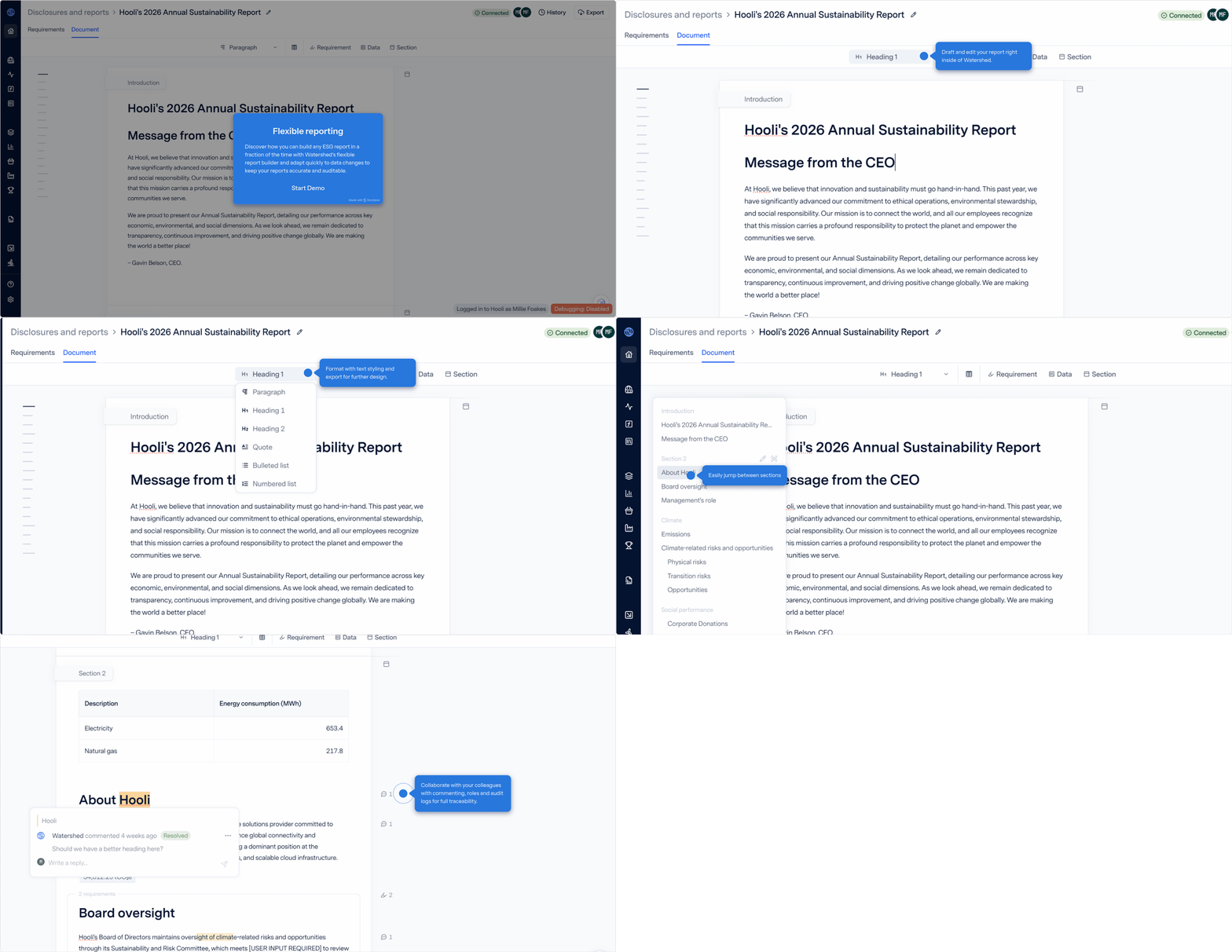
The new reporting experience gives you an adaptable canvas where teams can collaborate and respond to any reporting requirement—from GRI (Global Reporting Initiative) and ISSB (International Sustainability Standards Board) to annual impact reports and customer RFI (request for information) responses—in a single tool.
Reporting requirements have been proliferating: more frameworks, more local mandates, more stakeholder requests. In a complicated landscape, having a single tool that can handle the full range of what gets asked of you helps.
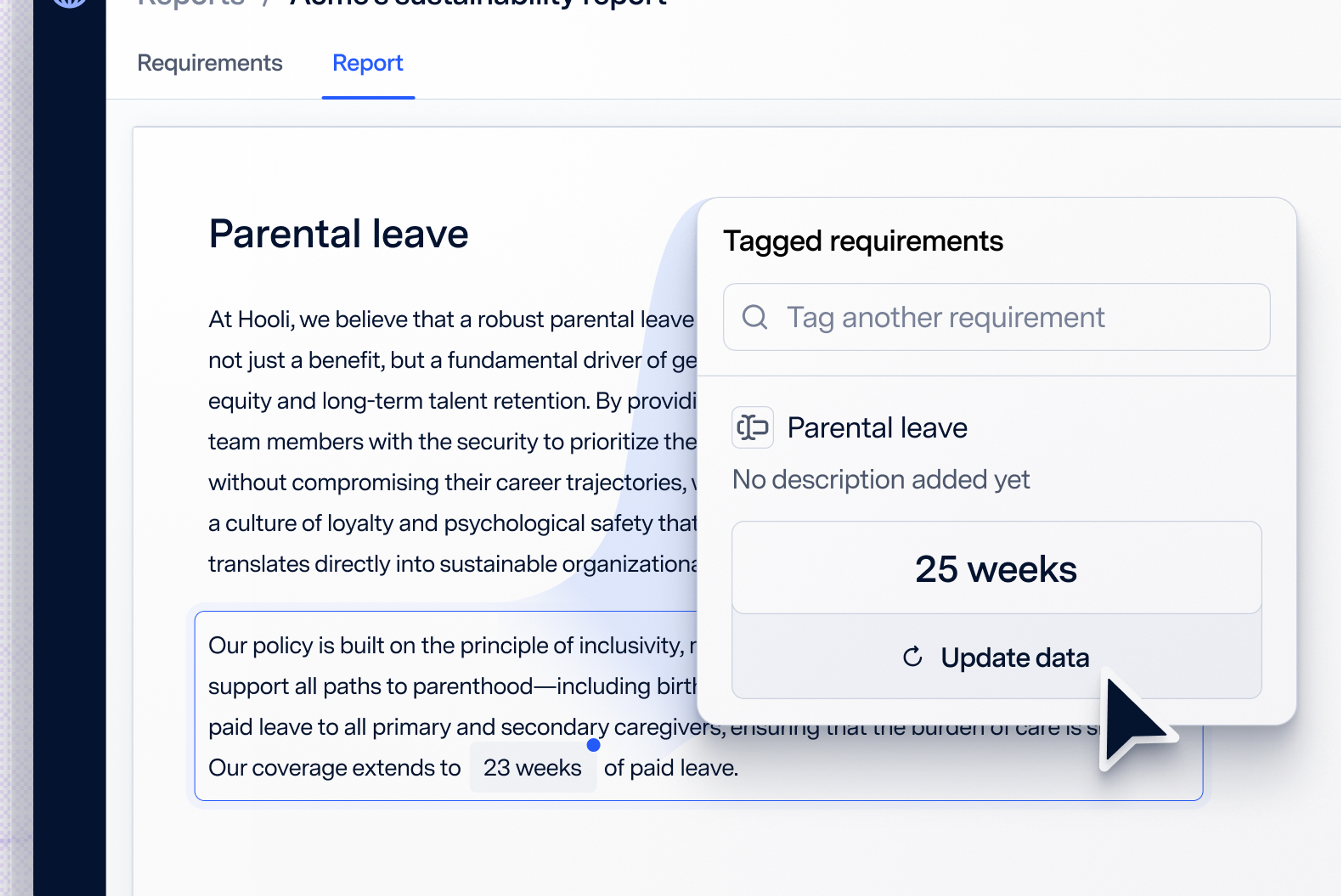
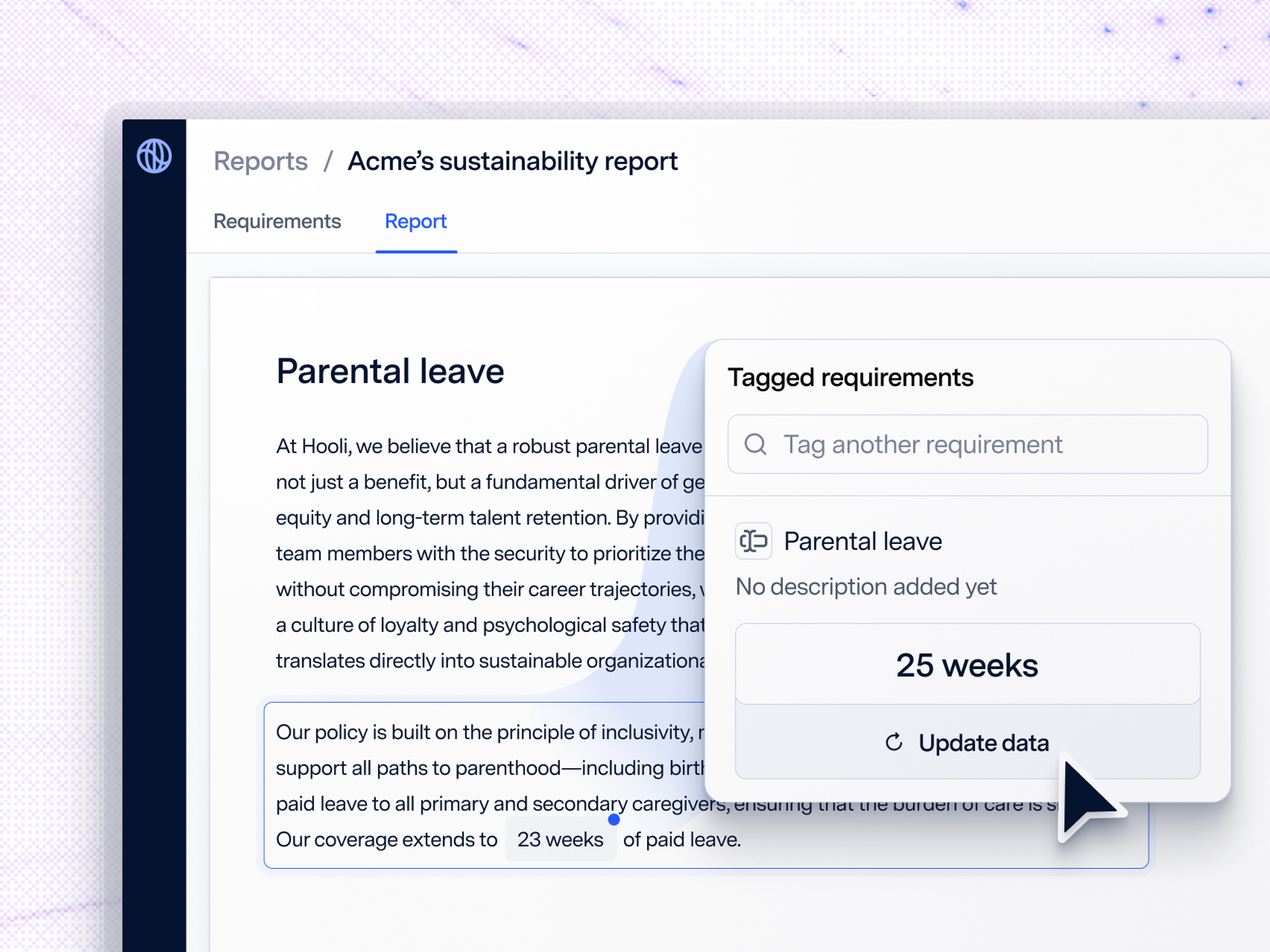
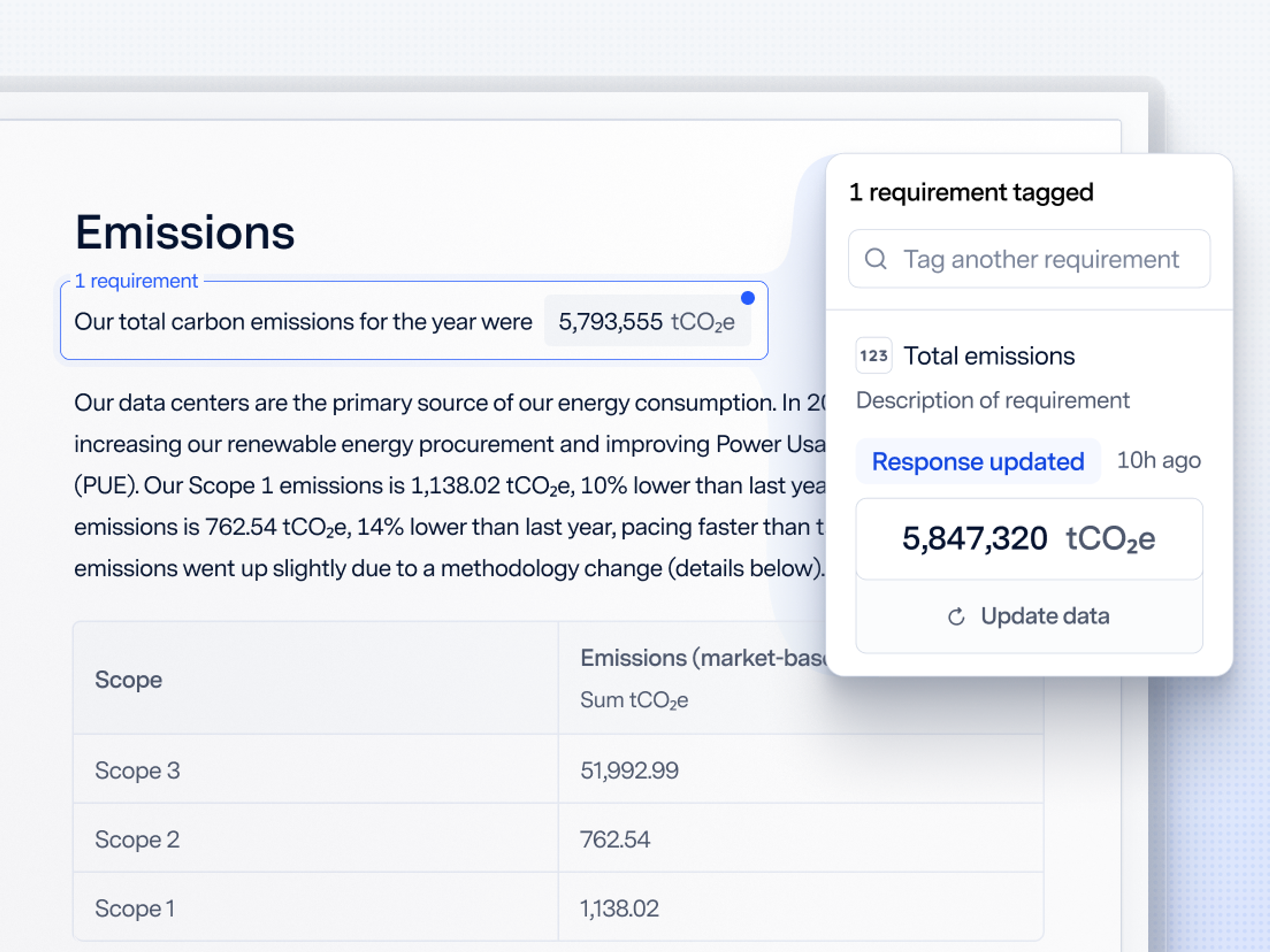
The report builder pre-populates data from your measurement and keeps it current as your underlying data changes. It also includes a stale data notification system—so if something upstream shifts, you know before you finalize a report and can update it with a single click. The idea is to reduce the number of places where a last-minute change can create a compounding error.
Use AI with built-in sustainability expertise
Last year, Watershed introduced AI-assisted drafting in our California SB 261 report builder. With this release, AI drafting extends across reports, and an AI advisor is now available right within the reporting experience. The advisor can help you draft answers based on prior reports or measurements, compare your report to peers in your industry, and identify gaps or areas to improve your reporting.
Watershed AI is purpose-built for the complexity of this work. It combines a comprehensive ESG data foundation with end-to-end transparency for greater explainability of outputs. It was developed by AI engineers and climate scientists working side by side to ground prompt engineering and evaluations in sustainability expertise.
The difference shows up most clearly in what the AI does with a given prompt. Ask a general-purpose AI to review a governance section of an ESG report, and it may suggest ways to polish language or follow general guidelines. Watershed AI is encoded with specifics on policy, your industry, and climate science to call out substantive gaps and opportunities.
Be ready for any data, any report, and any change
Regulations will keep changing and business shifts—acquisitions, restructurings, new geographies—will keep introducing new data challenges. Sustainability teams now have a platform that absorbs more of that complexity on their behalf, so they can spend less time wrangling systems and more time on the work that actually drives smarter, more sustainable business choices.
Customers are already seeing results from these capabilities. Using our AI utility bill scanner, one customer ingested 1,300 PDFs in two days, reducing the time spent on data aggregation by 90%. Another customer using AI report drafting completed their SB 261 report in two days instead of a month or more. These are the kinds of shifts that let sustainability teams reclaim their time—gaining speed without sacrificing rigor and explainability.
AI reporting for any ESG data is rolling out to early access customers now, with broader availability in the coming months. If you'd like to see the new features in action, join us for our upcoming demo webinars on March 31, 2026:
You can also request a personal demo here.