Watershed and Sweep are both sustainability management platforms, but they are built for different kinds of teams.
Watershed is designed for enterprise sustainability teams that need audit-ready product- and corporate-level emissions measurement, end-to-end ESG automation, and expert long-term partnership—without spending months configuring methodologies from scratch.
Sweep can work well for technical teams that prefer to self-serve and have the internal capacity to configure and maintain their own workflows.
Strategic overview
In recent Verdantix and Forrester assessments, both were named leading enterprise sustainability platforms, reflecting their shared commitment to high-quality data and AI-driven automation.
Industry recognition
Watershed and Sweep are recognized as Leaders in the 2026 Verdantix Green Quadrant for Enterprise Carbon Management Software—a benchmark of 21 vendors across 21 criteria.
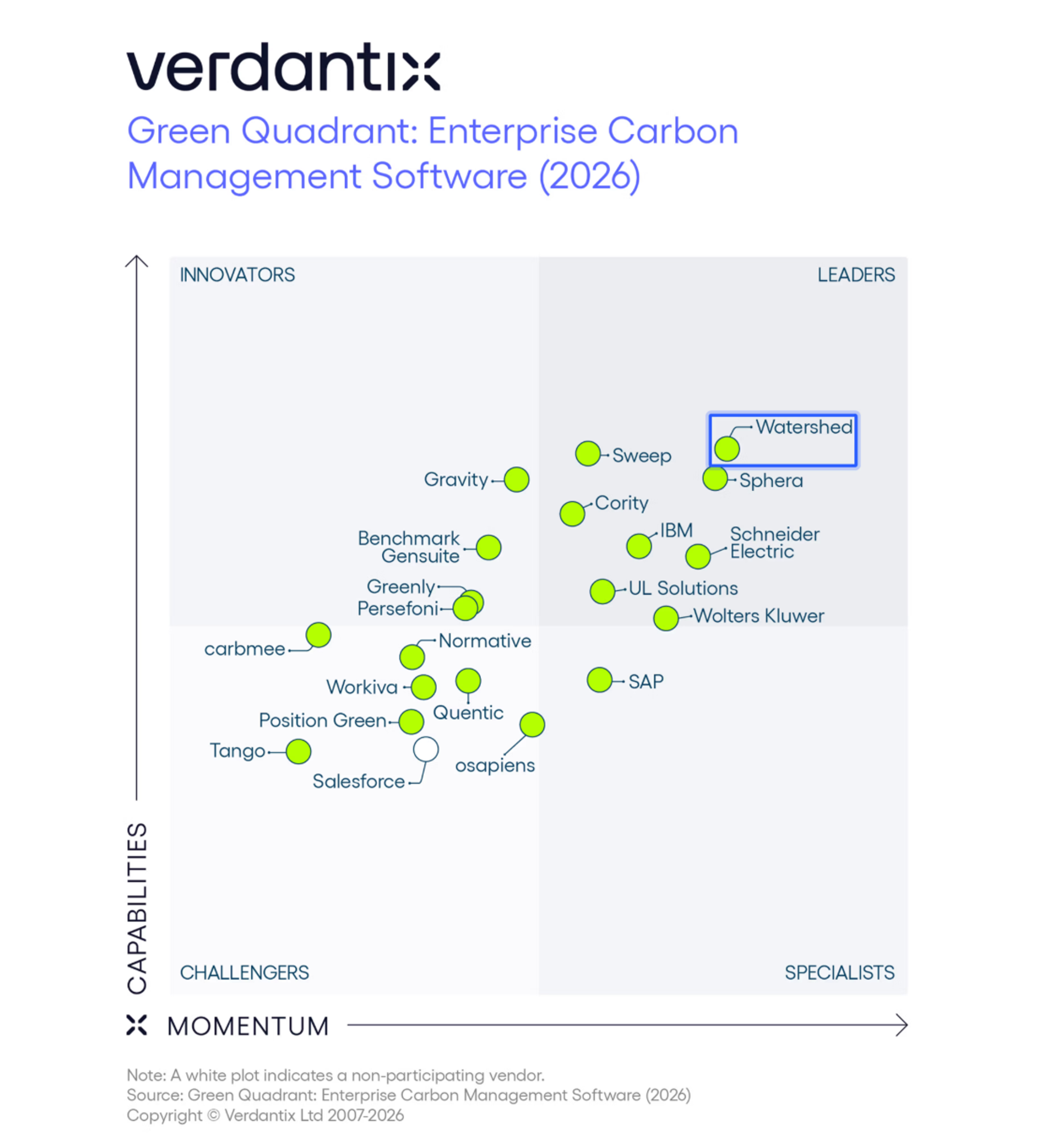
In Verdantix’s 2026 Green Quadrant for Carbon Management, Watershed outperforms Sweep on both capabilities and momentum. Watershed scores higher in areas like data acquisition, data quality control, carbon calculation methodologies, carbon calculation engine, and net-zero program management—making it the right choice for teams that need audit-ready rigor with global coverage and support.
According to the Verdantix 2026 Green Quadrant report, Sweep “has fewer resources than some of its competitors. For larger buyers, this could raise concerns about global support.”
Watershed vs. Sweep: What each platform does
Key definitions
Carbon management platform: Software that enables an organization to measure, report, and reduce greenhouse gas emissions across its operations and supply chain.
Sustainability platform: Extends beyond carbon management to include environmental, social and governance tracking (ESG), managing initiatives ranging from energy efficiency to responsible sourcing.
Watershed
Watershed is the enterprise sustainability AI platform. Companies including BBVA, Paramount, and DP World—plus 90+ Fortune 500 companies—use it to measure, report, and reduce emissions across all scopes, with:
- Pre-configured, customizable ESG methodologies aligned with GHG Protocol, SBTi, and FLAG
- Automated data quality controls (150+ error checks across 70+ error types)
- In-house climate scientists (21 on staff) and policy experts (CSRD, CDP, SB253, ISSB, etc.)
Sweep
Sweep is a sustainability management platform for measurement, reporting, and reductions with flexible, rules-based configuration. This can be a good fit for technically capable teams that want self-serve control and are prepared for the possibility of a longer setup period.
Sweep gives teams more hands-on configuration. Watershed gives teams an expert-built foundation that works out of the box, with customization options where needed.
Quick facts comparison
Category | Watershed | Sweep |
|---|---|---|
Best fit | Teams that want a pre-configured, audit-ready platform with expert partnership; customize as needed | Technical teams that want rules-based, self-serve configuration |
Emission factors |
|
|
AI focus | End-to-end agents for everything from data ingestion and cleaning to reporting, and reductions impact modeling for product design and procurement | AI for basic insights and platform configuration: emissions factor selection and dashboards, plus automated disclosure drafting |
Product carbon footprints |
|
|
AI-powered reporting |
|
|
Auditability |
|
|
Scale | 90+ Fortune 500 customers; offices in 6 countries; headquarters in UK and US | Offices in 3 countries; headquarters in France and UK |
AI capabilities
The biggest difference is not whether each platform has AI. It is what the AI does. Watershed’s AI is integrated across sustainability workflows for faster reporting and decarbonization progress. AI functionality develops quickly but as of Summer 2026, Sweep’s AI assistant is primarily focused on helping users configure the platform and draft reports.
Category | Watershed | Sweep |
|---|---|---|
AI focus | End-to-end agents for everything from data ingestion and cleaning to reporting, and reductions impact modeling for product design and procurement | AI for basic insights and platform configuration: emissions factor selection and dashboards, plus automated disclosure drafting |
AI auditability |
|
|
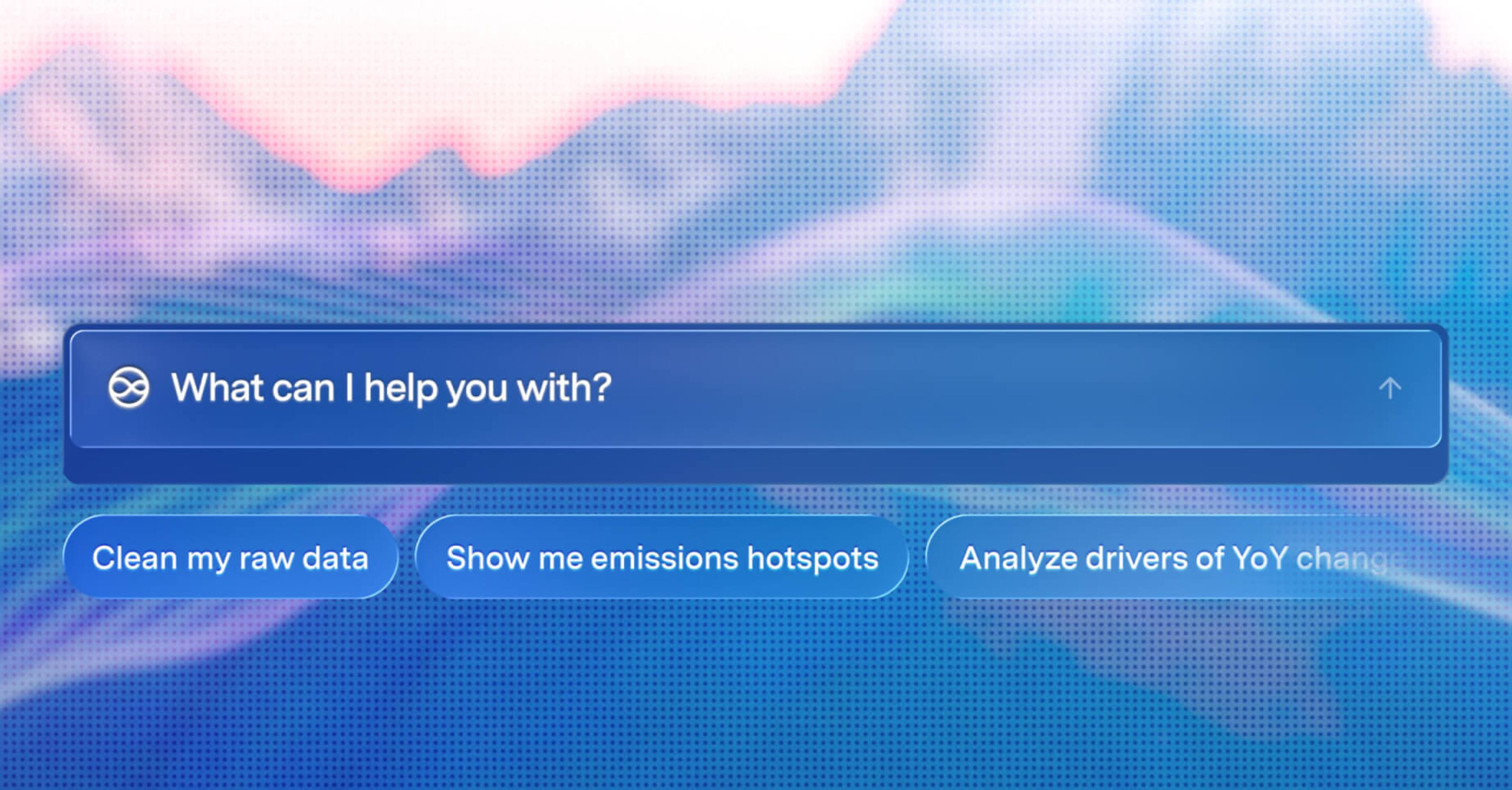
Watershed’s AI goes deeper and farther to help you complete and accelerate your sustainability work.
Watershed: AI that does the work
AI workflow | What Watershed AI does | Buyer outcome |
|---|---|---|
Utility bill ingestion | Extracts structured data from PDFs and invoices | Lower data ingestion effort |
Data management | Cleans messy files, normalizes units and currencies, deduplicates data, maps categories to emission factors | Less manual data prep |
Data analysis | Agents analyze data in seconds and provide structured answers to share with stakeholders | Faster data insights |
Product footprinting | Decomposes products into materials and processes, supports live assumption changes and scenario reruns | Faster PCFs and scenario analysis |
Reporting | Drafts disclosures grounded in verified data for frameworks such as CSRD, CDP, and SB 253 | Accelerated reporting cycles |
Real customer outcomes:
- 3-5 hours saved per week cleaning & transforming data for Royal Mail
- 6x faster measurement for Harris Farm Markets
- 2 days for Smiths Group to finish their SB261 report
- 2 weeks saved transforming data with agents for Specialized
We’re spending less time preparing documentation and doing calculations. Now, we can focus on driving action with the intelligence Watershed provides.
ThermoFisher Scientific
Scope 1, 2, and 3 emissions coverage
Scope definitions:
- Scope 1: Direct emissions from owned sources
- Scope 2: Purchased energy
- Scope 3: Everything else across your value chain—the hardest category to measure, and for most enterprises, the largest part of the footprint
Scope 1, 2, and 3 coverage
Both platforms cover all three scopes across major frameworks including CSRD, SB 253, and ISSB. Where they diverge is in how they handle the hard parts of scope 3.
Watershed's scope 3 approach
- Product Footprints: Auto-generates editable production graphs that break finished goods into materials and processes, enabling activity-based scope 3.1 measurement without waiting for supplier lifecycle assessments.
- Emission factors: Draws on 500,000+ annually updated emission factors spanning 148 countries and 400 industries, including its own open-source CEDA dataset, Ecoinvent, Agrifootprint, and HowGood.
- Automatic conversions: Currency conversions, unit normalization, and inflation adjustments happen automatically.
Sweep's scope 3 approach
Sweep offers supplier collaboration tools and covers the same 15 scope 3 categories, but emission factor mapping requires AI-assisted, though manual, setup for each category.
Scope 3 capabilities comparison
Category | Watershed | Sweep |
|---|---|---|
Scope 1-3 coverage | All 15 scope 3 categories | All 15 scope 3 categories |
Product carbon footprints |
|
|
Implementation and ongoing maintenance
Watershed
- Typical time to first measurement: 6-8 weeks
- Personalized and structured onboarding plan with unlimited expert support
- Low ongoing maintenance with dynamic methodology updates
Sweep customers have reported longer implementation timelines, driven by the need to manually configure platform logic before the platform produces results: For example, customers may need to build and maintain rules that tell the platform which emission factor to apply to each category of data.
Watershed’s methodologies are pre-configured and aligned to the GHG Protocol, SBTi (Science Based Targets initiative), and FLAG (Forest, Land and Agriculture) out of the box, with customization available where needed. Companies can easily tailor the underlying data and methodologies to fit their unique business.
Category | Watershed | Sweep |
|---|---|---|
Emission factors |
|
|
Methodology configuration | Pre-configured and customizable | AI-assisted, manual setup per category |
Why speed matters
Implementation speed and required maintenance matter beyond project management. Every extra month delays reporting readiness, consumes internal resources, and pushes back your return on investment.
Watershed's platform is built for automated rigor: 150+ integrated checks, full data lineage, and pre-configured methodologies designed to withstand auditor scrutiny. AI handles what would otherwise demand ongoing team effort—from ingesting and cleaning raw data, to unit conversions, gap-filling, and deduplicating data—with documented assumptions. The complexity stays in the engine, not with your team.
Data quality, auditability, and verification
Watershed's data quality approach
- 150+ built-in error checks across 70+ error types on every footprint
- Anomaly detection that flags issues automatically, then surfaces them for human review
- Data lineage: Every calculation carries full data lineage with emission factor metadata—boundaries, year, scope, source database, and methodology
- Guaranteed assurance (CSRD and California SB253): Program for customers who submit to CSRD or California SB253
- Track record: 100% of measurements on Watershed, when audited, have passed
Sweep's data quality approach
- Quality checks: Configured controls
- Data lineage: Emission factor-level structure produces aggregate category totals
Category | Watershed | Sweep |
|---|---|---|
Quality checks | 150+ error checks built in | Configured quality controls |
Calculation lineage | Deep traceability visualization from reported number back through each transformation step and source data | Row-level visibility |
Reporting
Watershed’s reporting workflows are designed to connect ESG data, AI-assisted drafting, peer benchmarks, and audit readiness in one platform so teams can collaborate together on a single document for any reporting requirement, such as CSRD, SB 253/261, CDP, and ISSB.
Because the Watershed platform connects directly to your business data and includes AI-assisted report drafting, companies with multiple disclosure obligations can scale quantitative data and qualitative responses to multiple reports in a fraction of the time. Watershed includes automated report-building capabilities for major disclosure frameworks, AI-assisted report drafting, and guaranteed assurance programs for CSRD and California reports, in addition to an extensive library of over 30,000 peer benchmarks to guide disclosure prep.
Category | Watershed | Sweep |
|---|---|---|
AI reporting support | AI co-pilot that goes beyond drafting: it compares your report against industry peers, surfaces gaps, and reviews your disclosure as an auditor would, with stale-data alerts when upstream numbers change before you file | AI drafts narratives and validates data, but lacks a peer-grounded review layer—no deep disclosure benchmarking or auditor-style report review |
Peer benchmarking | Disclosure content and emissions performance on over 30,000 global companies: publicly available peer responses and high-quality disclosure examples, reviewable section by section | Limited to emissions intensity benchmarks at the industry level |
Narrative collaboration | Offers both structured report templates and flexible, document-level collaboration to support any report—comments, approvals, and permissioning in one authoring flow | Offers report templates, but no document-level collaboration |
Learn why CDP chose Watershed for CDP reporting→
Supply chain engagement
Watershed
Watershed's Supply Chain product combines:
- Customizable supplier surveys
- An ESG database covering over 20 million companies
- AI-powered supplier matching
Sustainability and procurement teams can benchmark suppliers, identify product and corporate-level decarbonization hotspots, and model sourcing trade-offs in the same platform they use for ESG reporting.
Sweep
Supplier engagement tools are a core part of its positioning. Companies that want a platform for custom supplier surveys as well as deeper supplier-facing measurement and decarbonization may find its collaboration features well-suited to that use case.
Which platform fits your organization
Watershed may be the stronger fit when:
- You're preparing for third-party assurance under regulations like CSRD, SB 253, ISSB, or TCFD
- You need deeper lineage to trace each transformation, EF metadata, and source data
- Scope 3 and product-level emissions are a material part of your footprint
- You need methodology expertise built into the platform, faster implementation, and the ability to customize when needed—without owning every methodology decision from scratch
Sweep can work well when:
- You want a more self-serve, configurable platform and have internal capacity to build and maintain the rules
- Supplier engagement workflows are a primary focus
Questions to ask before choosing a platform
- How much internal capacity will implementation and maintenance require?
- Who maintains mapping rules when standards update?
- Can you show a sample audit trail from a reported number back to source data?
- What is your audit pass rate?
- How does your AI avoid hallucinations and preserve calculation lineage?
- How does the platform automate calculations and scenario modeling for PCFs?
Frequently asked questions
What's the difference between a carbon management platform and a sustainability platform? Carbon management platforms focus on measuring, reporting, and reducing greenhouse gas emissions. Sustainability platforms extend that into broader ESG tracking—social and governance data, energy efficiency programs, responsible sourcing. Both Watershed and Sweep started with carbon management and have expanded into full sustainability reporting. Watershed emphasizes pre-configured methodologies and AI-driven automation. Sweep emphasizes workflow and platform configurability.
Which platform is better for scope 3 emissions? Watershed provides more granular scope 3 coverage, including AI-accelerated product carbon footprinting and activity-based measurement across all 15 categories without requiring supplier lifecycle assessments. For complex supply chains or product-level emissions, Watershed's automated approach reduces manual effort. For supplier engagement workflows, both platforms offer strong collaboration tools.
How do their AI capabilities compare? Watershed's AI accelerates sustainability work: data cleaning, utility bill ingestion, product footprints, report drafting. Watershed customers have saved hours per week—and in one case, an estimated 12 weeks per year—on data cleaning and analysis. As of Summer 2026, Sweep's AI helps you configure the platform for rules and dashboards, access basic insights, and draft reports.
Can I customize Watershed's data and methodologies? Yes, Watershed is pre-configured but fully customizable:
- Override emission factors or bring your own
- Choose / override calculation methods
- Apply custom allocation rules
- Build custom dashboards and workflows
Is Watershed hard to use? Watershed's AI agents handle the most time-consuming work: cleaning raw files, converting units and currencies, matching suppliers, ingesting utility bills, and flagging data quality issues before they surface in your report—saving “hours and hours and hours,” according to Izzy Sheridan, Associate Sustainability Manager at like e.l.f. Beauty. Sustainability teams managing complex, multi-entity footprints will have more to configure than teams with simpler needs—but with Watershed, the complexity lives in the data, not the platform.
What should I know about pricing? Both platforms are enterprise-priced and require a discovery conversation before quoting. When budgeting, factor in not just the license cost but implementation time, ongoing internal resource requirements, and what additional tooling may be required such as last-mile reporting or PCF solutions.
How do Watershed and Sweep align with CSRD? Both platforms support CSRD disclosure. Watershed's methodology library is pre-configured for CSRD alignment, with automated data quality controls, AI-assisted drafting, multi-stakeholder document collaboration, and audit trails built for third-party assurance. Watershed also has a global in-house policy team and offers a Guaranteed Assurance program for CSRD and California reporting. Sweep covers CSRD with AI-assisted drafting and DMA visualization.
Is Watershed built for European companies? Yes. Watershed has European headquarters in London, with offices in Paris and Berlin:
- Large in-house policy team tracking CSRD/ISSB globally
- 21 climate scientists actively reviewing CSRD alignment
- European customers including Spotify, Klarna, BBVA, and 10 of the FTSE 100
Who are Watershed's key customers? BBVA, Paramount, DP World, and 90+ Fortune 500 companies use Watershed. See customer stories.
Ready to see it in action? Get a demo