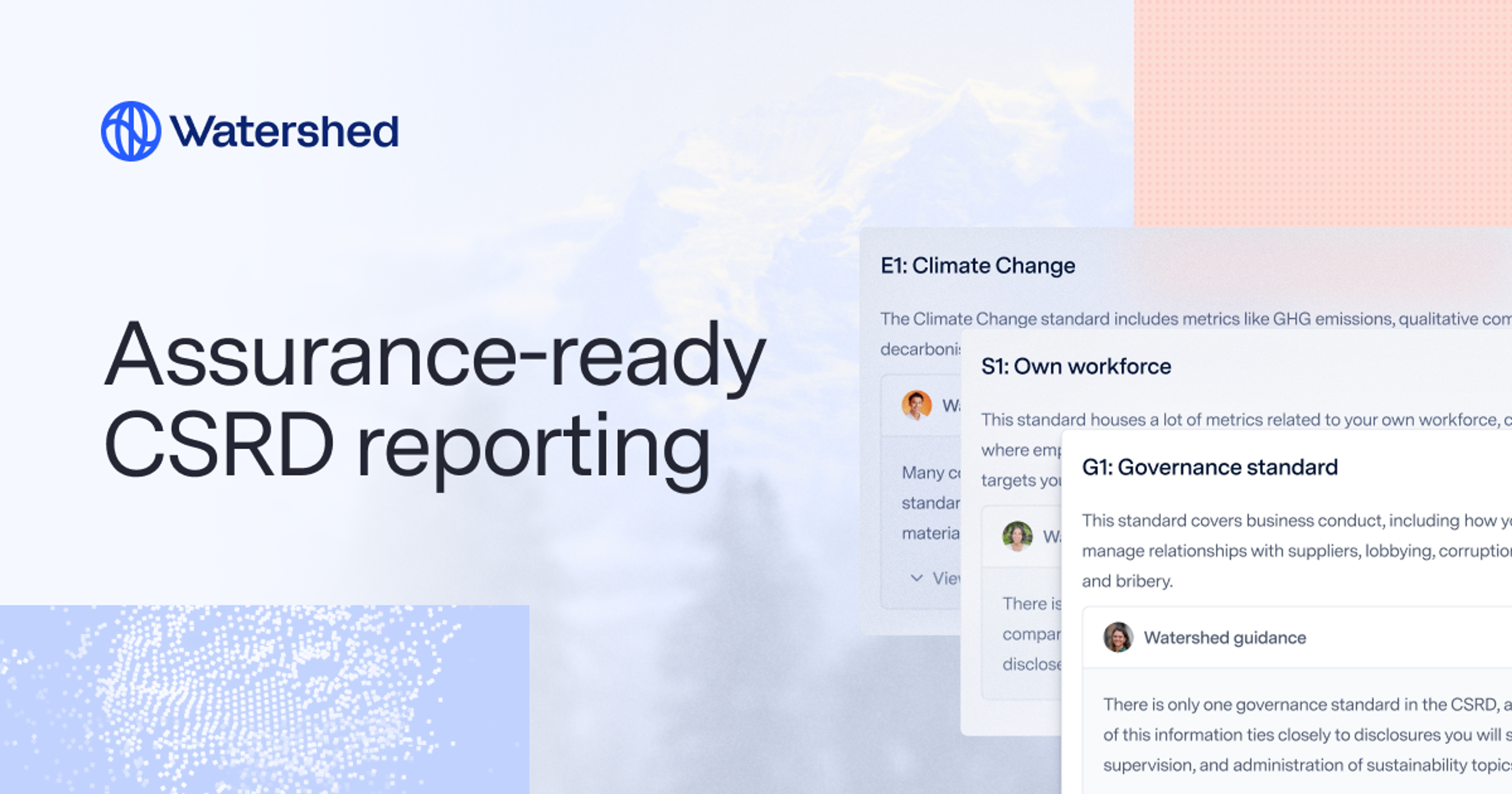
Choosing the best software to streamline compliance with the European Union’s Corporate Sustainability Reporting Directive (CSRD) starts with understanding the requirements you need to meet. This guide explains the revised CSRD scope and timing, which European Sustainability Reporting Standards (ESRS) requirements to solve first, and how six CSRD software platforms compare.
What this article covers
- This guide evaluates software for CSRD reporting specifically, not general ESG platforms. It evaluates 6 software solutions that support ESRS E1.
- The February 2026 Omnibus package cut CSRD's scope to roughly 6,000 companies, and the Stop-the-Clock directive pushed most timelines back two years. Most newly in-scope EU companies will report in 2028 on FY2027 data; former first-cohort reporters and Article 40a non-EU groups follow separate timelines.
- Not every ESRS requirement lands at once. ESRS 1 and ESRS 2 are mandatory regardless of materiality, ESRS E1 is the only topical standard you must justify in writing if you omit it, and Wave 1 companies can defer E4, S2, S3, and S4 for 2025 and 2026 data. That sequence should drive your evaluation.
- There's no universal winner. The right platform depends on which topics are material to you, how complex your value chain is, and whether your bottleneck is emissions data or disclosure assembly.
What changed about CSRD scope and timing?
The rules changed in stages. The Stop-the-Clock Directive delayed first reporting for companies that would otherwise have reported on FY2025 or FY2026 data. Directive (EU) 2026/470 then narrowed the mandatory CSRD population for financial years beginning on or after 1 January 2027.
In broad terms, EU undertakings and groups are in scope where they exceed both €450 million in net turnover and 1,000 employees. Certain non-EU undertakings with significant EU activity fall under Article 40a, with dedicated third-country standards still being developed. Do not use “under 250 employees are out of scope” as a general rule: group structures, reporting cohort, legal form and the applicable national rules matter. The revised CSRD generally applies from financial years beginning on or after 1 January 2027 to EU undertakings and groups exceeding both €450 million in net turnover and 1,000 employees. Companies already reporting under the first cohort and certain non-EU groups are subject to separate scope and timing rules.
CSRD requirements and timing
Please note that the wave labels above are legacy shorthand used to map the former CSRD reporting cohorts onto the post-Omnibus framework; they are not categories in the revised CSRD.
Two timing details matter for a software decision. Member states have until mid-2027 to transpose the revised directive, so national requirements may diverge in the interim, and some may gold-plate. And the Simplified ESRS cut mandatory data points by more than 60 percent, which changes what you actually need to collect. A platform designed only around the original ESRS may not reflect the revised requirements, although the original standards remain relevant for certain FY2026 reporting situations.
For full detail on scope determination and ESRS structure, see our guide to CSRD carbon reporting for EU companies.
Which CSRD requirements should you solve first?
CSRD isn't a single deadline. Requirements arrive in a sequence, and the sequence tells you what your software has to be good at first.
Mandatory now, no materiality exemption. ESRS 2 is fundamental and likely to generate material information for most undertakings, but the revised ESRS apply a materiality filter and generally do not require non-material prescribed information. You also need the double materiality assessment itself before the sustainability statement can be scoped, and limited assurance is required from your first reporting year. The Omnibus removed the planned move to reasonable assurance, and a dedicated EU limited assurance standard is due by July 2027.
Effectively mandatory: ESRS E1. Climate is the only topical standard carrying a rebuttable presumption of materiality. Assess E1 as non-material and you owe auditors a detailed written justification. Every other topical standard can be omitted on materiality grounds without a specific justification requirement. E1 is also the heaviest lift in the set: Scope 1, 2, and 3 emissions, targets, transition plan, and scenario analysis.
Deferred for Wave 1. Under the Quick Fix reliefs, Wave 1 companies may omit E4 biodiversity, S2 value chain workers, S3 affected communities, and S4 consumers for 2025 and 2026 data. This applies to Wave 1 only. Wave 2 and Wave 4 companies are on different timing and shouldn't plan around it.
Materiality-dependent. E2 pollution, E3 water, E5 resource use, S1 own workforce, and G1 business conduct. S1 and G1 are material for a large share of companies, so don't assume they're deferrable.
Not yet live. Digital tagging under iXBRL isn't mandatory until the Commission formally adopts the XBRL taxonomy. Approval was expected in the second half of 2026 and there's no official updated timeline. Treat tagging as a roadmap question, not a gating requirement.
The practical read: emissions data is the earliest, largest, and most audit-exposed workload for most in-scope companies, while several social and environmental topics are either deferred or materiality-gated. That doesn't make the other standards optional. It does mean the order you solve them in isn't arbitrary.
How should you evaluate CSRD software?
An effective CSRD solution must manage the reporting cycle end-to-end and easily adapt to evolving regulatory scopes, requirements, and timelines. The table below highlights the key evaluation criteria for CSRD software.
CSRD software evaluation criteria
A note on the last row: because the sustainability statement is filed with the annual report, integration with finance systems and consolidation logic matters more than it does for voluntary reporting. Ask vendors how they handle entity-level consolidation and restatements, not just data ingestion.
The best CSRD software platforms in 2026
Watershed
Why Watershed for CSRD: the new Simplified ESRS report experience is now available within Watershed’s reporting platform.
Best for: companies where climate is a dominant material topic, Scope 3 is complex, and teams want measurement, reporting, and decarbonization workflows in one platform.
Strengths: Scope 3 methodology and supplier engagement; traceable calculations and data lineage; Watershed guidance and policy text alongside requirements; auto-populated supported quantitative responses; AI-assisted drafting, assignments, collaboration, and review workflows. Watershed’s in-house policy team tracks Omnibus and Simplified ESRS developments.
ESRS coverage: full qualitative support across topics, with auto-populated quantitative data for supported data points required under the Simplified ESRS. Custom ESG can cover optional data points where Watershed does not provide methodology.
Clients of note: BBVA, BARCO, CISCO, DP World, Smiths Group, Walmart
Novisto
Why Novisto for CSRD: ESG data management with strength in last-mile reporting assembly.
Best for: companies reporting across several frameworks that need a single data layer feeding multiple outputs. Full ESRS disclosure platform.
Strengths: framework library breadth, questionnaire and data request management, growing DACH presence and EU support footprint.
Salesforce Net Zero Cloud
Why Net Zero Cloud for CSRD: sustainability data managed inside the Salesforce platform.
Best for: Salesforce-native organizations with existing platform investment and admin capacity. Carbon-first platform.
Strengths: native Salesforce data model and reporting, familiar admin tooling, low incremental procurement friction.
Sweep
Why Sweep for CSRD: EU-headquartered platform with CSRD and ESRS workflows built in.
Best for: EU teams that want double materiality and value chain workflows. Full ESRS disclosure platform.
Strengths: CSRD-native workflow design, double materiality tooling, value chain data collection, EU regulatory proximity.
Workiva
Why Workiva for CSRD: a connected reporting platform built for financial-grade disclosure, now extended across ESRS.
Best for: companies integrating sustainability and financial reporting in one controlled process. Full ESRS disclosure platform.
Strengths: mature audit and controls tooling, XBRL and iXBRL experience from financial filing, strong multi-framework support, established auditor familiarity.
Position Green
Why Position Green for CSRD: ESRS reporting software paired with in-house advisory services, from a Nordic vendor close to EU regulation.
Best for: Nordic and European companies that want a more configuration and services-heavy approach alongside their reporting software. Full ESRS disclosure platform.
Strengths: double materiality assessment workflows, ESRS and multi-framework reporting, EU Taxonomy coverage.
CSRD software comparison table
Why choose Watershed for CSRD?
Watershed connects sustainability measurement and reporting in one platform. Its Simplified ESRS experience lets teams map their DMA to requirements, choose how to respond, use guidance and policy text, auto-populate supported quantitative responses, and draft qualitative responses with AI. Assignments, collaboration, traceability, and review workflows help teams move from data collection to an assurance-ready report.
Watershed is especially strong when climate is material and Scope 3 is complex. Supplier engagement, traceable calculations, 2.3M emissions factors, and annually assured methodologies support the underlying data and help teams reuse it across reports.
In summary, Watershed combines CSRD readiness workflows, an enterprise-grade climate data foundation, and audit-ready governance—so companies can publish CSRD disclosures with confidence and defend them under assurance. But depending on your company’s unique needs and challenges, there are plenty of options for platforms to help scale CSRD reporting.
Request a demo to see how Watershed can address your specific CSRD needs.