Today, we announced the next phase of Watershed AI: agents focused on cutting costs and driving revenue through sustainability work. Here's what's new.
Expert-built AI skills
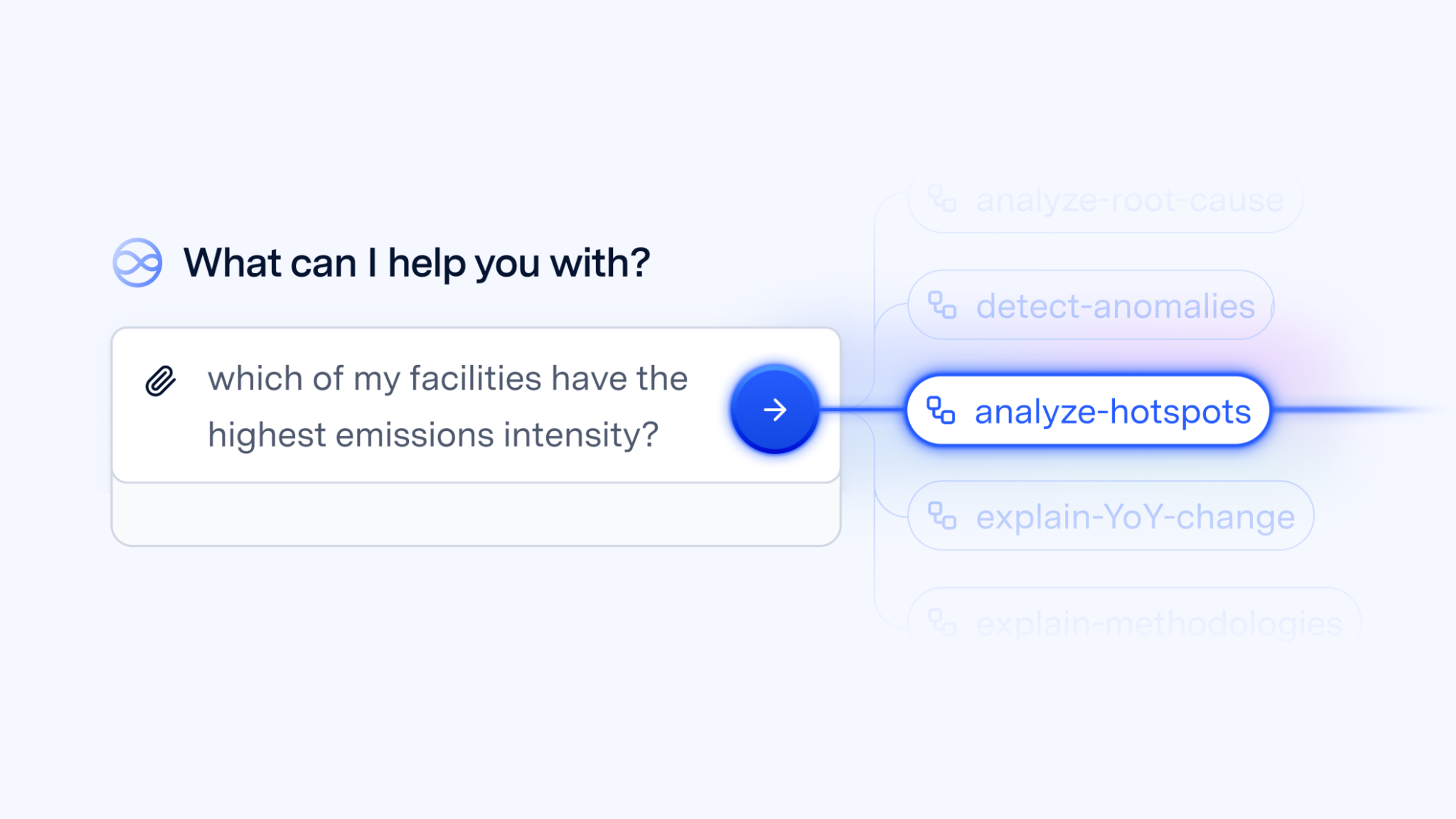
Watershed agents now come with a library of expert-built skills—preconfigured capabilities designed by climate scientists and sustainability professionals. Skills include common sustainability tasks like anomaly detection, methodology comparison and analyzing the root cause of year-over-year changes. They give teams an immediate starting point for using AI in their workflows without requiring weeks of configuration or prompt engineering. They also increase the accuracy of AI outputs because skills encode sustainability intelligence directly into the process.
Skills help sustainability teams save time and money on manual analysis or outside expertise. With the domain expertise packed into skills, agents can reliably automate more of the data cleaning, anomaly detection, and audit preparation workflows.
Agents for utilities spend analysis
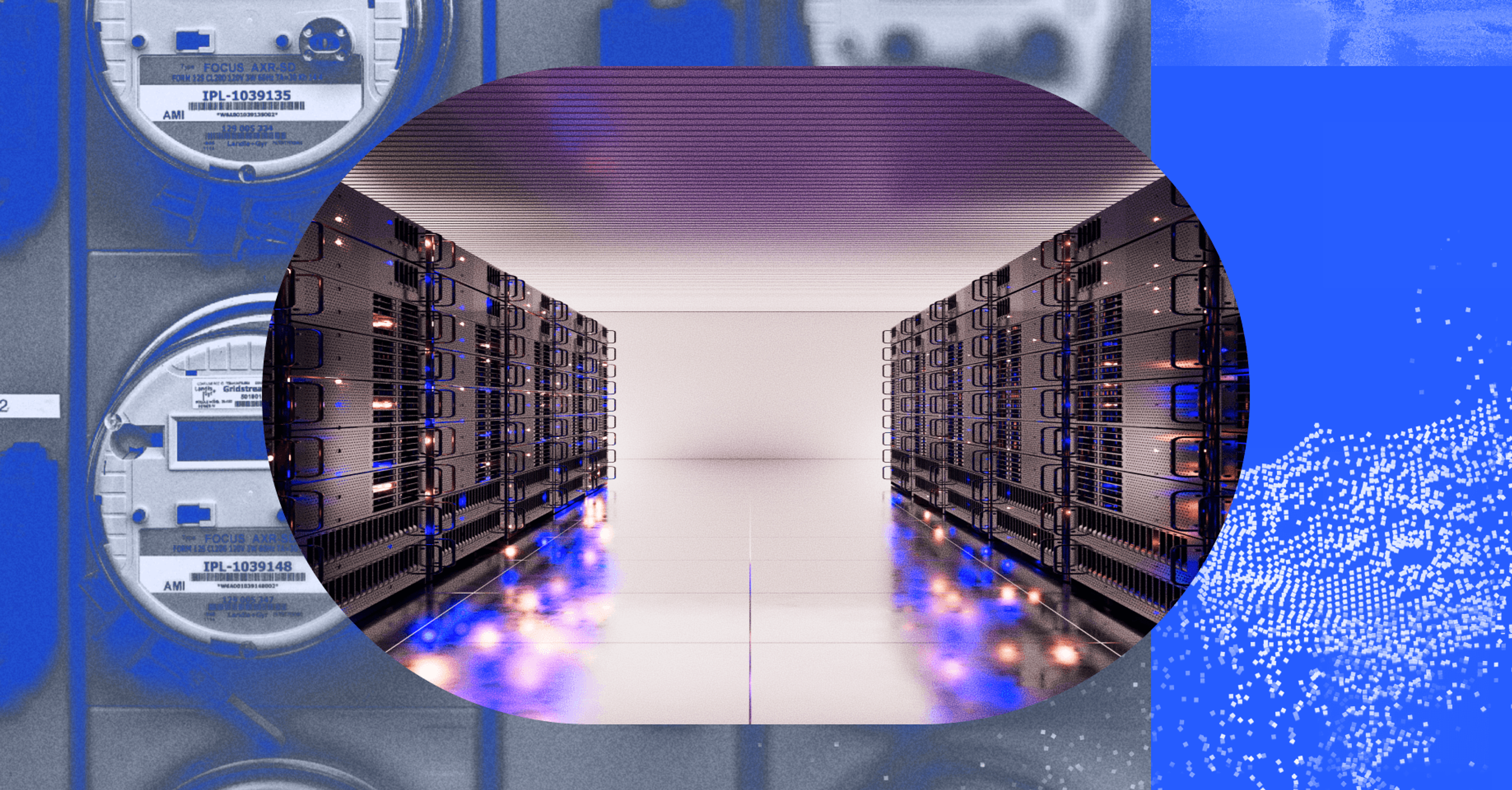
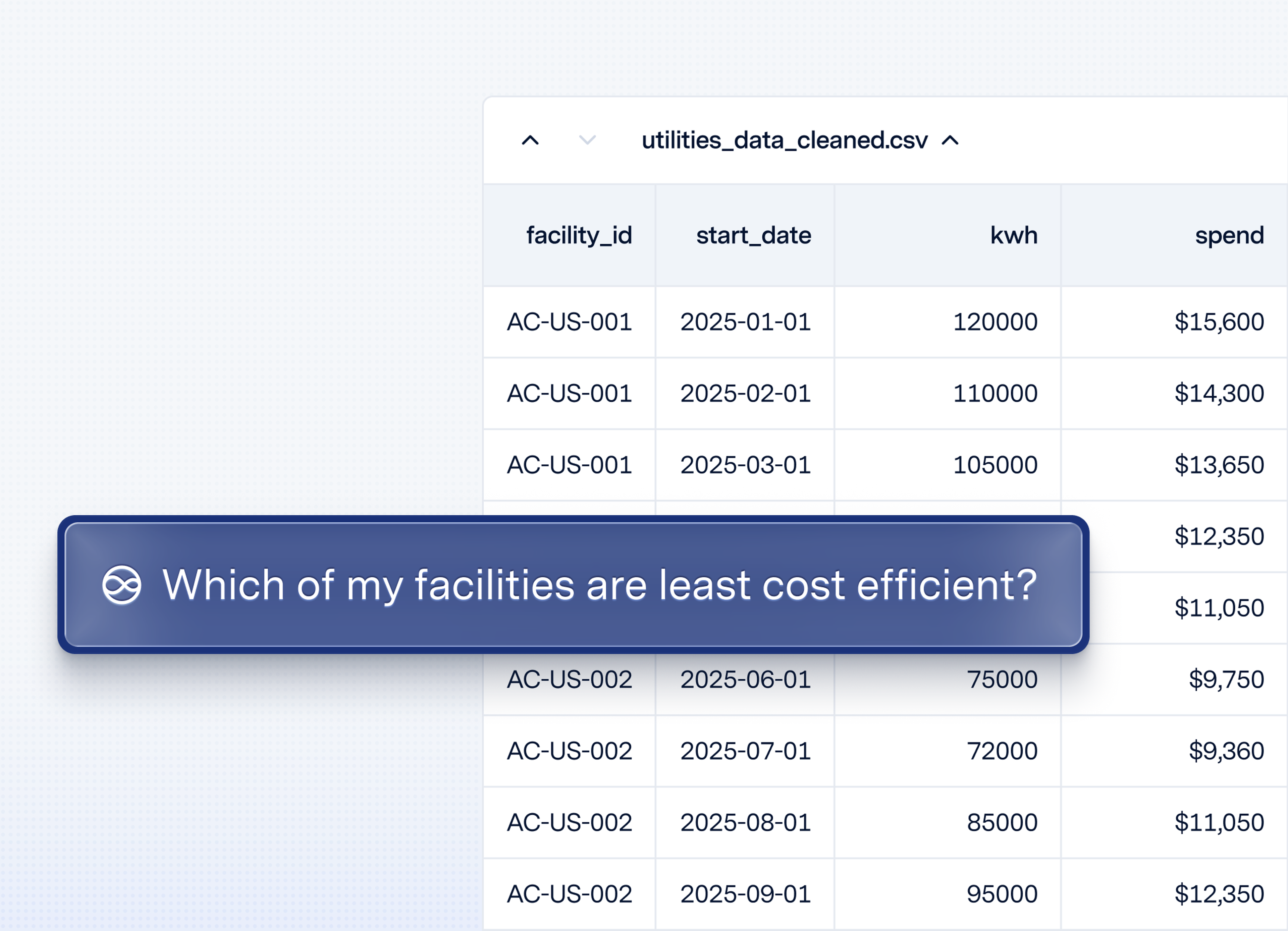
Decarbonization often delivers cost savings, but finding them requires pairing emissions data with financial data—an analysis that has historically been blocked by fragmented data systems and lack of time for the analysis. Now you can upload your utilities data and ask Watershed agents to analyze emissions and spend side by side. See where energy efficiency investments are paying off, where costs are rising despite reduction efforts, and where the biggest financial opportunities lie. By quantifying the money saved for every KwH of energy or tonne of CO2e avoided, teams can clearly demonstrate how their decarbonization initiatives deliver cost savings for the business.
Agents for PCF editing at scale
When your company has thousands of products, a single material or process change can have an outsized impact on cost and decarbonization potential. But until now, editing and maintaining accurate PCFs across a portfolio that large was so impractical that few teams could model those changes in advance—or keep their footprints current as they made improvements.
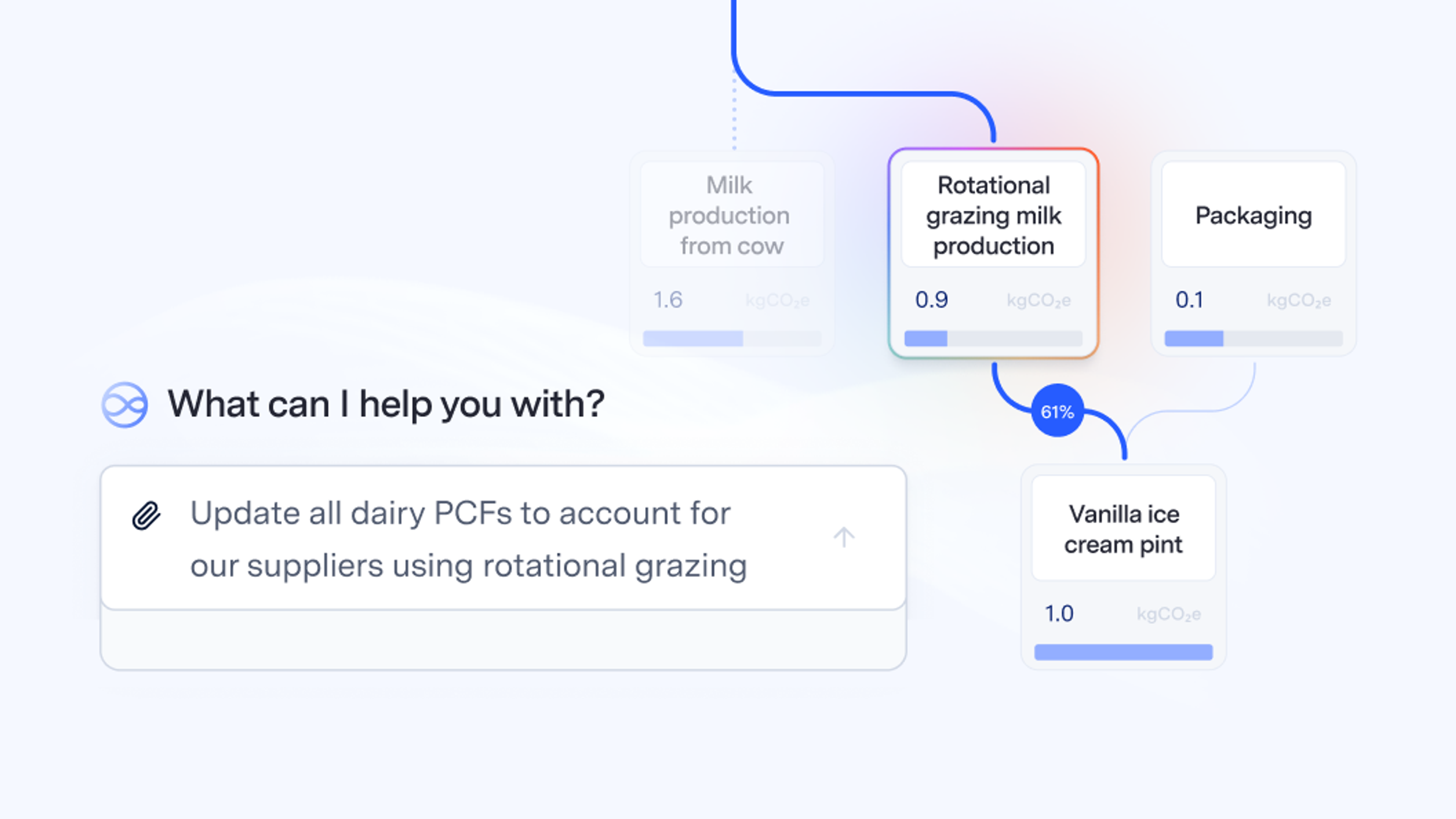
For the first time, companies with thousands of products can keep PCFs accurate and current across the entire portfolio. With Watershed agents, you build PCFs and make changes that cascade consistently in moments: switch a material, add detail about a supplier, adjust a process, and watch each change carry through every affected product.
The benefit is twofold. First, you can make a more defensible business case for the decarbonization levers you want to pursue by modeling the cost and impact of a change before you commit to it. What happens if you switch to a supplier on a greener grid? Does buying palm oil from deforestation-free suppliers at a 12% cost increase actually deliver the emissions reduction you need?
Second, proving the impact of those choices at scale helps you win revenue from customers who weigh sustainability in their RFPs and purchasing decisions. That turns sustainability from a cost center into a business driver—without weeks of manual analysis.
"Partnering with Watershed has allowed us to accelerate our product carbon footprint work. Calculating product carbon footprints in this way allows us to experiment with product data in a digital lab, testing ideas and understanding what the product carbon footprint impact would be to inform product development and further support our customers," said Anna Yates, head of EHS and Sustainability at Albany International, an early user of these features.
New collaborations in food and beverage data
Starting today, Watershed is home to the most extensive food and beverage dataset ever compiled in one place. Customers can now use data from Agri-footprint (Mérieux NutriSciences | Blonk), WFLDB (Quantis), and HowGood in their PCFs.
Each data source is translated into Watershed's production graph structure, making it fully editable, decomposable, and interoperable with other sources. You can pull apart any model to find emissions hotspots, swap in supplier-specific data, run scenario analyses—like modeling the impact of shifting sourcing regions—and compare data sources side by side, all within the same environment you already use to build and manage PCFs.
For food and beverage companies, where agricultural supply chains span millions of farms and emissions drivers vary dramatically by commodity and region, this is the kind of data depth that has been either inaccessible or impossibly manual to maintain. Read the full announcement.
Sustainability AI across the Watershed platform
These new features build upon a layer of AI agents integrated across the Watershed platform. In September 2025, we introduced Product Footprints, accelerating the process of building PCFs for all the materials you buy and surfacing previously unseeable decarbonization paths. In spring 2026, we added agents for data ingestion, data cleaning, data analysis, and report drafting. Our early customers have reported time savings of 65%-80% in data cleaning and gained efficiency that has shrunk ESG reporting time from a multi-month process down to weeks or days.
“Already, the Watershed agents are saving us maybe three to five hours a week, really reducing that manual work and data processing,” said Emma Bayliss-Chan, Head of Climate Strategy & Risk at Royal Mail.
How to access these new AI features
If you are a Watershed customer, talk with your account team about these features. If you are not yet a Watershed customer, you can request a demo of these new capabilities to see them used with your own data or context. Request a personal demo or join us for one of the following demo webinars to get a closer look.
- July 7: Demo of all agents:
EMEA time zone | North & South American time zone - July 9: Demo of agents in Product Footprints