Many companies set climate targets, but few have a plan for how to achieve them. Andrea Nemer Soto has spent her career in that gap, translating high-level commitments into the procurement decisions, supplier relationships, and data infrastructure that actually move emissions. We sat down with her to talk scope 3, sustainability software, and what separates ambition from achievement.
You didn't start out in climate. You started in marketing and business strategy, even taught it at the university level in Mexico. How did you end up here?
I built my career at the intersection of business strategy and environmental impact — and I got there through business strategy, not environmental science. While teaching, I had to cover a module on sustainable development—and what I learned genuinely changed my perspective.
I started looking at products, operations, and supply chains through a systems thinking and life-cycle lens. Once I understood how deeply environmental and social impacts are embedded in the way business works, I knew that intersection was where I wanted to build my career. That led me to formal sustainability training in Mexico and eventually a master's degree at Arizona State University.
What keeps pulling me back? Sustainability is one of the few fields where you have to think holistically—connecting strategy, operations, risk, innovation, and human behavior all at once. I've always been drawn to how systems shape outcomes, and this work gives you the opportunity to reduce real harm while helping organizations make smarter, more resilient decisions at scale.
You've since built sustainability programs across manufacturing, retail, apparel, and tech, across the U.S., Canada, Mexico, Latin America, and Germany. What does that cross-sector, cross-border background give you?
Perspective and practicality. I've seen sustainability from multiple viewpoints: factory floors, supplier environments, product development, procurement, enterprise reporting, corporate strategy. That breadth helps me connect the macro and the micro. I can look at a company's high-level climate commitments and immediately understand what they mean in practice—for facilities, frontline employees, reporting, procurement decisions, data quality, operational constraints, suppliers.
Sustainability stalls when it sits in a silo. The advantage I've built over time is that I can translate between ambition and execution. I know how to connect strategy to the actual mechanisms that make change happen.
With so many domains to work across—LCA, responsible minerals, water risk, supplier engagement, emissions reporting—how do you decide where to focus when everything feels urgent?
I prioritize the intersection of material impact, business leverage, and execution readiness. Many issues matter in sustainability, but not all of them will move the enterprise—or the environmental outcome—at the same scale at the same time. My starting point is always: where are the biggest impacts, where does the business have real influence, and where can progress build momentum for broader change?
Earlier in my career, I wanted to solve everything at once. Today I still think systemically, but I execute more selectively. The goal is to focus on the highest-leverage moves, embed accountability, and build durable capability across teams—so the work outlasts any single initiative or individual.
There's often a gap between a company announcing a science-based target and actually operationalizing it. Where do you feel that gap most acutely, and how do you close it?
The biggest gap is almost always translation. A science-based target can be clear at the enterprise level, but business units need to understand what it means in terms of real choices, metrics, and accountability. That's especially true for scope 3, where progress depends less on direct control and more on influence, data quality, supplier engagement, and procurement practices.
The way you close the gap is by making sustainability operational—and being very consistent with the message, constantly reinforcing it with key stakeholders. You embed it into policy, procurement requirements, contracts, reporting. You follow up consistently every quarter with clear KPIs. Once that happens, the target stops being aspirational and starts becoming executable. I've spent most of my career working in exactly that space—between ambition and execution.
Scope 3 is where ambition tends to stall for most companies. What does meaningful supply chain engagement actually look like in practice?
It means moving well beyond supplier questionnaires and making sustainability part of how you manage commercial relationships. Supplier engagement has to be structured—with clear expectations, credible data, performance visibility, and an ongoing dialogue about actual emissions and how they can be reduced.
A key to successful supplier engagement has been building the underlying emissions measurement system to get real visibility into which suppliers have the largest share of your scope 3 footprint and which ones should be prioritized. From there, you deploy ESG assessments, embed sustainability requirements into contracts, integrate results into scorecards. At scale, supply chain engagement is really about influence and alignment. You're not asking suppliers to act in isolation—you're creating the conditions for decarbonization, so it becomes part of how a supplier gets evaluated and improves over time.
There's a tendency to treat scope 3 as inherently fuzzy—hard to measure, harder to influence. How do you push back on that?
I push back on the idea that "difficult" means "unmanageable." Scope 3 is more complex than scope 1 and 2—no question. But Watershed was a game changer in that regard. Having the ability to improve how we measure and get granular emissions data for each supplier helps us prioritize and focus on the suppliers and decisions that can actually move the numbers.
Internally, that means being clear about where influence exists and what the practical levers are. With suppliers, it means treating decarbonization as a capability-building exercise, not just a reporting request. And the pattern I've seen across my career holds here too: the data gets better when the business starts using it to make decisions.
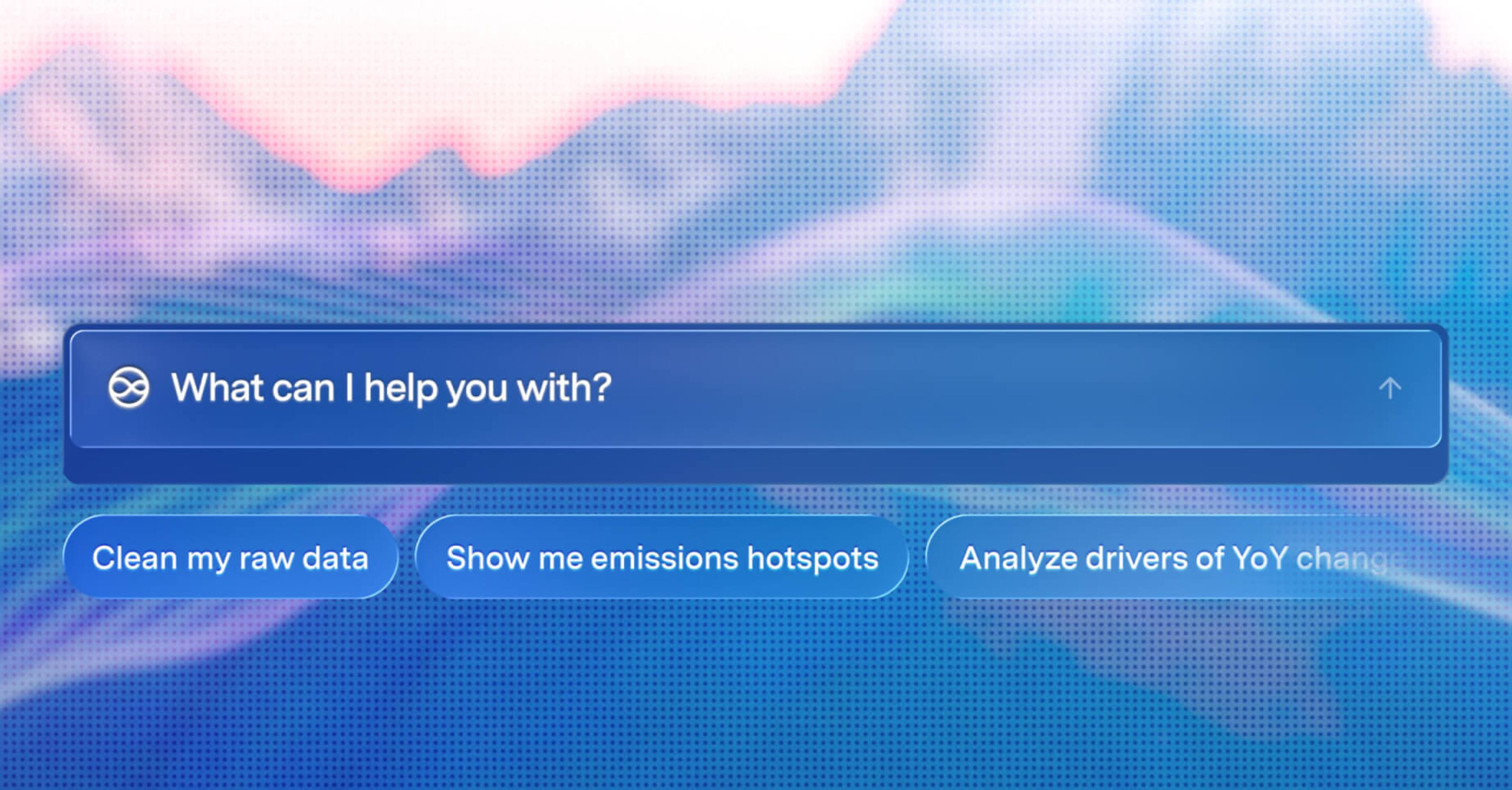
You use API-based data collection with Watershed rather than manual pulls and spreadsheets. How has that affected your work?
What changes first is time and attention. We spend less time on manual collection, reconciliation, and calculations—which means we can spend more time on analysis and decision support. That's a meaningful shift. Watershed doesn't just make reporting faster; it makes the data more useful.
It also improves consistency and confidence. Automation reduces avoidable errors, creates better traceability, and supports a more disciplined reporting rhythm. The benefit isn't just that the data becomes readily available—it's that you have a stronger process around completeness, comparability, review, and auditability. For sustainability teams, that's a real maturity step: moving from assembling numbers to actually managing performance, and from spending time on data to spending time on sustainability solutions and innovations that actually reduce environmental impact.
You’ve reported for and achieved great ratings from CDP in your career. Does external reporting drive better internal behavior, or does it mostly surface work you were already doing?
Honestly, both. A framework like CDP doesn't create a strong sustainability program on its own—but it's an effective forcing function because it brings rigor, comparability, and accountability. It surfaces whether the work is actually embedded: whether governance exists, whether the data holds up, whether the strategy is credible.
The most useful thing external reporting does is force organizations to connect the dots internally. It shows where systems are strong, where they're fragmented, and where better coordination is needed. Much of the underlying work should already be happening—but a framework like CDP absolutely accelerates internal discipline.
There's a lot of pressure on corporate climate commitments right now—skepticism from multiple directions. How do you stay anchored?
I keep James Hansen's Storms of My Grandchildren within reach at all times. It helps me maintain perspective. Hansen spent decades translating climate science into terms that demanded action. It keeps me honest about what’s at stake.
Beyond that, I stay anchored by focusing on fundamentals. Climate risk, resource constraints, supply chain resilience, regulatory expectations—these aren't temporary issues. The language around them may shift, and the external environment may get loud, but the underlying business need doesn't go away.
I also stay deliberately curious about what's coming. AI is revolutionizing how we work but I’m watching what comes next even more closely. Quantum computing, in particular, has practical implications that could fundamentally change our field: faster, more accurate environmental footprint measurement, real-time supply chain analysis, dramatically faster LCAs, and the ability to model solution pathways, even predictively, before problems materialize. Paired with breakthroughs in fusion energy, these aren't distant possibilities - they're going to reshape what effective sustainability practice looks like. Staying grounded in the science and open to new ways of working isn't optional in this field. It's the job.
I stay disciplined on what's material, what's measurable, and what creates long-term value and resilience. That mindset has served me across every sector I've worked in. The context always changes—the core question never does: how do you help the business make better decisions for the long term?
What's your advice to a sustainability leader trying to build a program with real staying power?
Focus on operational relevance. Reporting matters, strategy matters, ambition matters—but the work becomes durable when it's built into how decisions actually get made. Spend less time proving sustainability matters. Spend more time designing it into the machinery of the business.
For me, the motivation has always come from the same place: turning complexity into clarity, and clarity into action. That's the work that matters most. And when you do see it take hold—when a program becomes part of how the business operates, when a team starts using data to make real decisions—that's incredibly rewarding.
Watershed helps sustainability teams measure, track, and act on emissions across operations and supply chain. To learn how Watershed can help your team move from ambition to execution, explore our supply chain solution or request a demo.