Over the past year, agents have cut data cleaning time by 80% and taken reporting from months to days. But moving faster to produce measurements and reports was never the end goal. Sustainability is about influencing action.
To actually reduce emissions, you need people who sit outside of your team–facilities, contracts, product designers, and suppliers—to act. Our research shows that the most effective sustainability teams over the last few years have become skilled at collaborating with decision-makers across their companies to drive down emissions in ways that advance the company, like reducing energy to drive down emissions and costs together.
Earlier this year, we introduced Watershed agents for data cleaning, analysis, reporting, and product footprinting. Today we’re announcing the next stage of Watershed AI: a deep collaboration layer for Watershed agents that bring the rest of your company into the work.
What’s new for Watershed agents
- Dashboards: Use AI to build dashboards in moments that arm leadership and teams across your organization with data and insights.
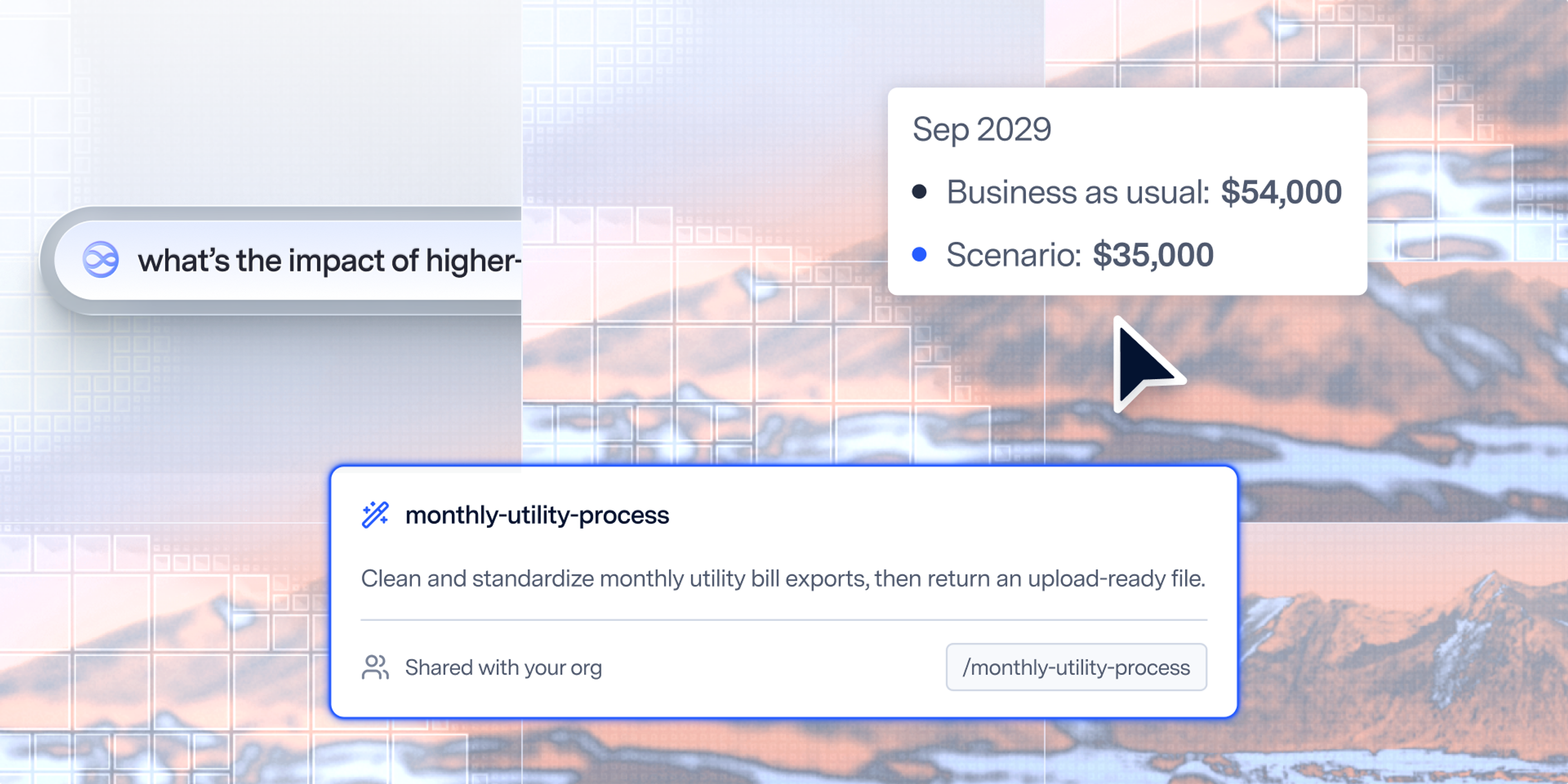
- Custom skills: Create and share custom skills that tackle any process you do repeatedly in a predictable and auditable way.
- Workflows: Define the specific steps agents and members of your team need to tackle complex workflows, so you can distribute work without losing control.
- Company knowledge: When you share information about your company–like your latest business travel policy–agents store it in this shared and secure body of context, and then use that knowledge across future sessions and across teammates.
- Memory & self-improvement: Agents can remember customization and details on how your company works across sessions, so each interaction makes the next one sharper.
We’re also announcing an expanded data foundation, with our built-in sustainability database growing by 4x to more than 2.3 million emissions factors. That foundation is deeper than any other sustainability platform, and gives your team more precision and accuracy to drive decisions.
AI is now abundant in sustainability, but trust is not. The distance between an impressive demo and an agent you can trust with consequential sustainability work is vast. That’s why we’ve invested so heavily in the underlying data, safeguards and sustainability intelligence needed to match the complexity of this work.
We’re proud to see Watershed customers put agents to the test, customize their own use cases and drive action. Kyle Robertson of Hain Celestial shared that he used agents to build deep brand-level decarbonization strategies, turning a multi-month, costly process into a couple of days’ work. “The Watershed agent has been absolutely transformative,” said Robertson. “My advice to people who are thinking about using an agent is do it, and do it now.”
You can learn more about collaboration with Watershed agents and our new advanced features at our recap webinar on September 29th.
What agents power next: Watershed Energy Management
Join the notification list to join our community of sustainability teams tackling energy. Get invites to energy-focused events and product updates.
Energy is one of the fastest-moving costs in businesses, with climbing demand, volatile price swings, and power reliability moving from a facilities concern to a board-level one.
More companies than ever need an energy strategy, and sustainability teams, who are already experts on utility data, have begun driving this work. The impact is straightforward: reduced energy usage reduces emissions.
Managing energy across a complex business can feel impossible: companies find out energy costs when the bills arrive, and by then, the decisions that drove numbers–which chiller ran all night, which site’s meter broke in March, which lease renewal locked in a bad rate—are months behind them. The data needed to start building a strategy is fragmented: consumption sits in meters, cost sits in invoices, and the sites and equipment behind both sit in spreadsheets, with nothing connecting them.
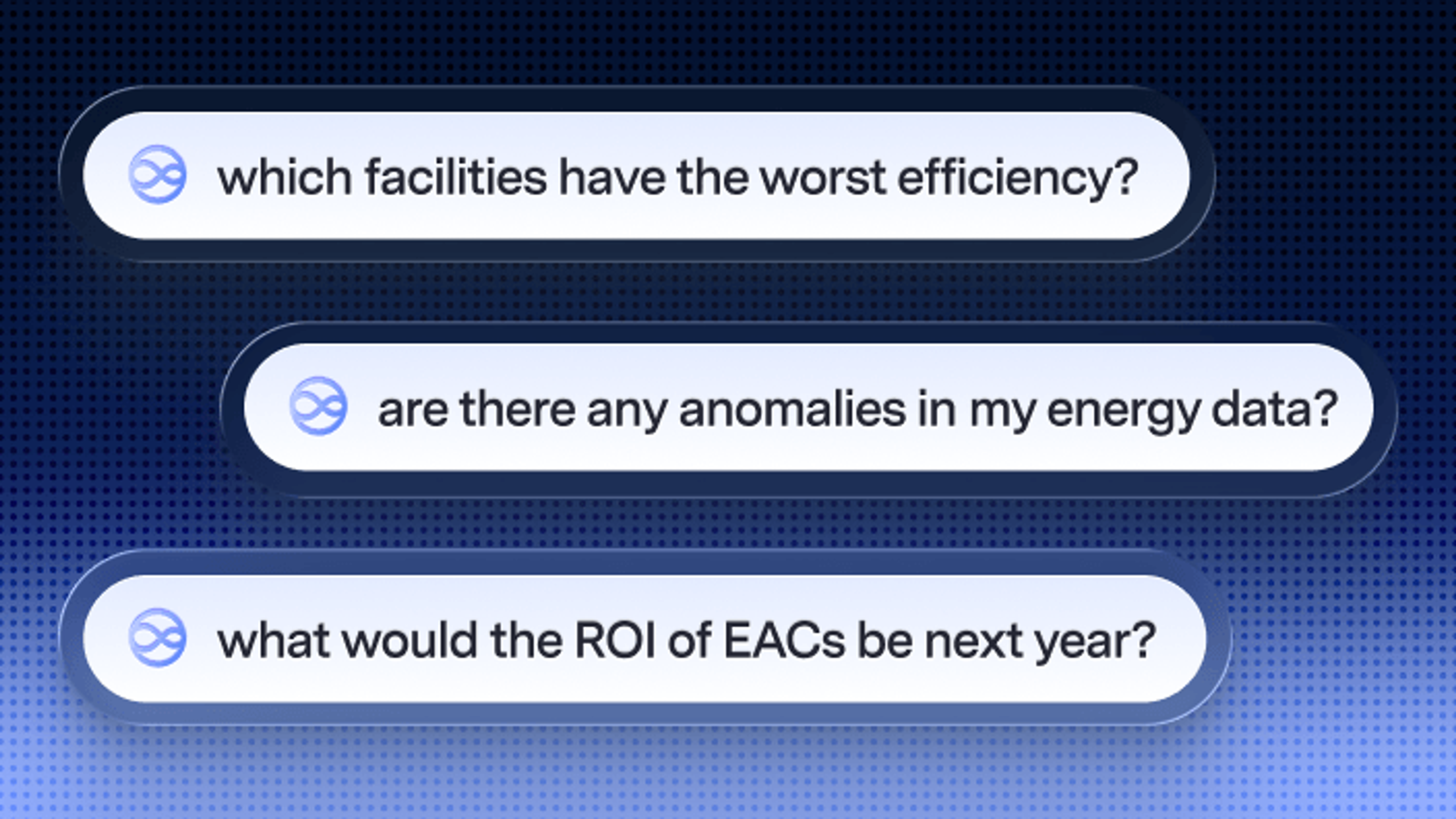
Over the past months, we’ve tackled energy head-on, working closely with Watershed customers to build the early version of Watershed Energy Management: the first unified AI platform for managing energy costs and emissions together. It builds on everything already possible in Watershed today, like ingesting and cleaning utility data, spotting anomalies and outliers, analyzing facility efficiency, and more.
Watershed Energy Management centralizes energy data into one source of truth, with verified utility data, weather-normalized usage, equipment condition, and emissions factors in the same place, bringing energy strategy out of broken spreadsheets and fragmented tools.
Then, Watershed turns that data baseline into plans with dollars and tonnes attached: which equipment to replace, which sites to retrofit, where solar pays off.
Our work on energy began in 2020, when Watershed began work with leading companies on their scope 1 & 2 emissions. Since then, we’ve ingested energy data for more than 324,000 facilities, covering nearly 1,400 TWh of annual energy use, and funded $500 million in new clean energy investment with customers that add nearly 400 MW of capacity to the grid. Across that work, we’ve seen the need for tools that make it easy to consolidate messy data from paper bills to disparate software, expert analysis that Heads of Sustainability and facilities managers alike understand, and roadmaps for action.
Watershed is working with leading companies like Albany International to take a strategic approach to energy management. At Albany, energy has become a higher company priority as rising demand and grid constraints reshape the grid. The need to focus on energy was underscored when an international manufacturing plant saw a potential energy capacity limit that didn’t just threaten to raise the cost of energy, but could potentially limit the ability to manufacture there at scale. In that moment, energy became a clear leadership-level priority.
“Working with Watershed gives us greater visibility into our energy landscape and helps us compare opportunities consistently, from equipment upgrades to alternative fuels and on-site generation,” said Anna Yates, Sustainability and EHS lead at Albany International. “That insight enables us to focus investment where it can create the greatest value for both the business and the environment,” she added.
Watershed Energy Management is in use today with a cohort of early customers. It will be generally available to purchase in 2027. Join our community of sustainability teams tackling energy to get product updates and invites to events with experts.