Welcome to the climate economy
The world economy is transforming to run on zero carbon. And it’s happening faster than most boardrooms realize.
It’s bigger than one election cycle. It’s built on science, math, and dollars and cents. It’s the defining economic shift of our lifetimes: a future where, across more and more of the economy, the smartest financial decision is also the right one for the planet.
We call it the climate economy.
The shift has already begun: The climate economy is taking shape, and reshaping the future of business and our planet.
We see it among our customers: hundreds of companies spanning every industry and region, including more than 100 of the global Fortune 500, making real investments in sustainability. We see it in the growing global movement toward climate-related disclosure and regulation. And we see it in the numbers: increasingly, what’s good for the planet is good for business.
Where climate leaders are market leaders.
In the climate economy, climate leadership becomes synonymous with market leadership. The companies that invest in sustainability gain competitive advantage through cost savings, operational improvements, risk avoidance, and new growth.
This is already true for some businesses, in some sectors of the economy. According to Watershed research, since 2020, the 100 companies with the most impactful climate programs cut emissions by nearly 1 gigatonne (cumulative) and outperformed the S&P 500. They treated decarbonization as a growth strategy, not a cost center, and the economics proved them right.
In the climate economy, this dynamic will spread to every sector—from energy and transportation to agriculture, aviation, construction, and more.
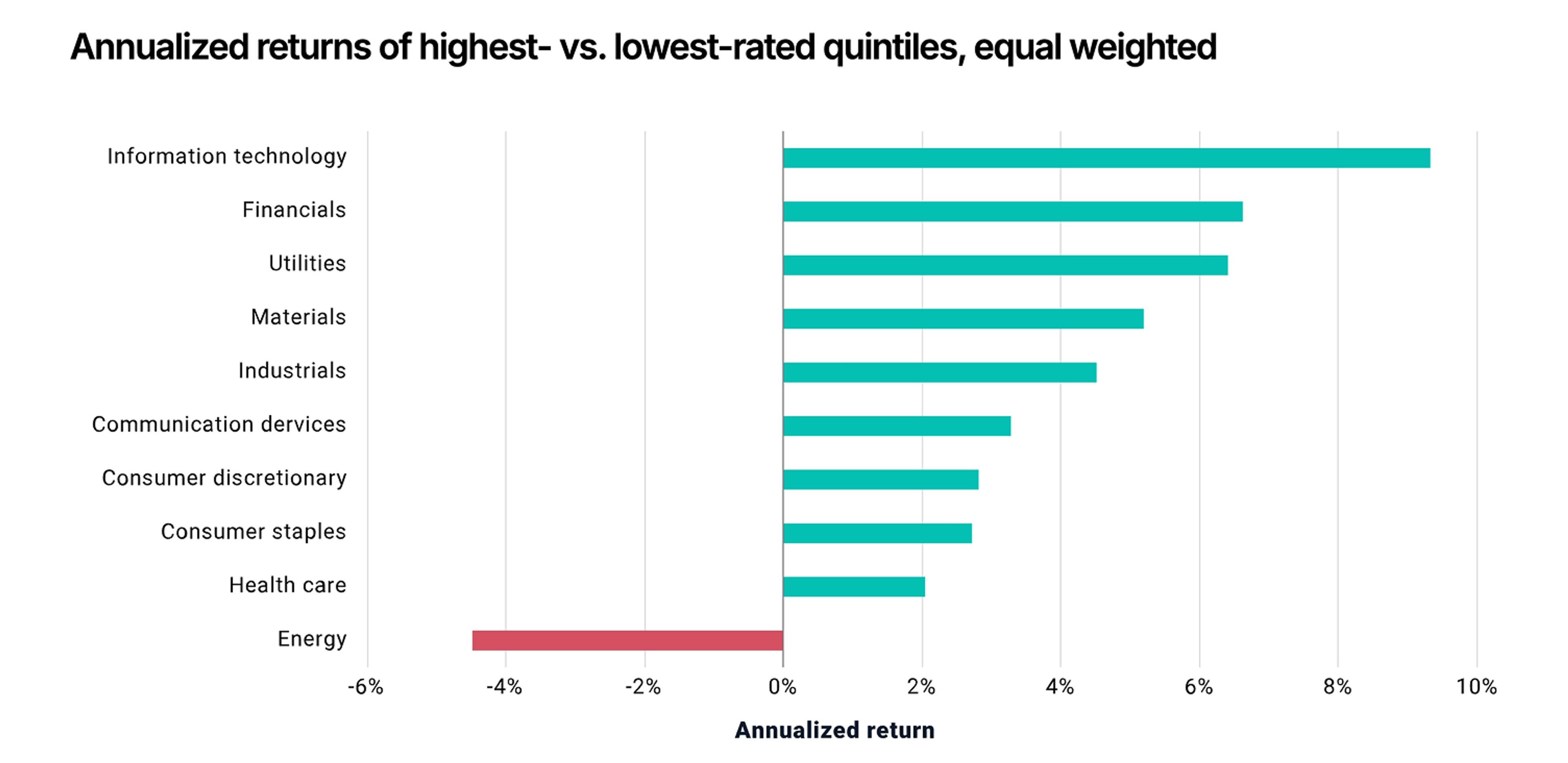
According to analysis by Morgan Stanley Capital International (MSCI), climate leaders outperformed laggards over 11 years in every sector except energy.
Data from Sept. 30, 2013 to March 29, 2024. Quintiles formed monthly on adjusted climate-change theme scores within each sector; real estate excluded for lack of pre-2016 data. Source: MSCI ESG Research, “Managing Climate-Change Risks vs. Chasing Green Opportunities,” Oct 2024.
Where the cheapest kilowatt is also the cleanest.
Over the past decade, the cost of wind, solar, and EV batteries has plummeted while installed capacity and adoption have surged. Solar and wind are now the cheapest new electricity in many places on Earth, and in the US, used electric vehicles have a lower total cost of ownership than comparable gas-powered cars. The old tradeoff between clean and cheap is disappearing: Companies are switching to renewables for the energy bill, not the press release.
Watershed's head of science Dr. John Bistline has published research in The Electricity Journal showing that corporate clean energy procurement drives real regional emissions reductions—the kind that show up in grid data, not just in annual reports.
The chart below tracks the cost and deployment of three low-carbon technologies in the US over the past decade: as the price of wind, solar, and EV batteries declined, installed capacity and cumulative sales grew by orders of magnitude.
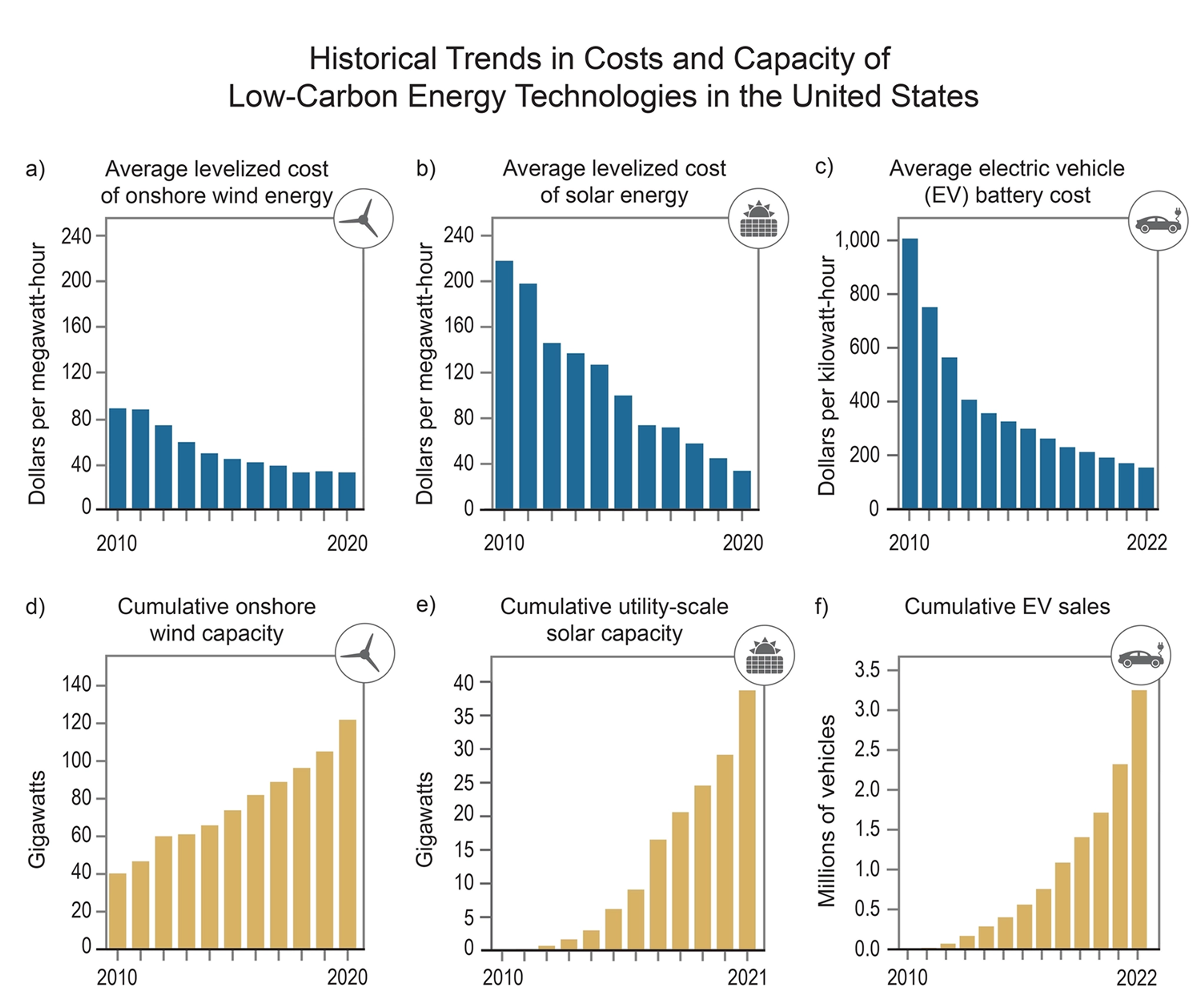
Costs of onshore wind (a), solar photovoltaics (b), and electric vehicle (EV) batteries (c) have decreased sharply since 2000 (data shown here start in 2010), as the cumulative capacities of wind and solar generation (d, e) and the cumulative number of EVs sold (f) have increased. Figure credit: Electric Power Research Institute, National Renewable Energy Laboratory, NOAA NCEI, and CISESS NC. Source: Fifth National Climate Assessment (NCA5), Chapter 32: Mitigation, Davis et al.
Where decarbonization wins deals.
The procurement landscape has shifted. CDP's Supply Chain program now has 270+ major buyers requesting environmental data from roughly 45,000 suppliers—a fourfold increase since 2019. According to a 2025 survey by IntegrityNext, 70% of global companies have already embedded sustainability into their procurement process, and more than 80% view it as a strategic priority—pointing to the growing role of carbon data in purchasing decisions.
Rigorous, transparent data means smarter climate and financial decisions in every sector. A retailer switching to renewables cuts its electricity bill and its carbon footprint in the same contract. A manufacturer with product-level carbon data wins customers that competitors can't reach. A bank pricing climate risk into its portfolio outperforms one that doesn't. In France, public hospital tenders are now required to weigh medicine suppliers' carbon footprints—meaning a pharma company with rigorous product-level LCA data can win bids that competitors without it cannot. Climate data is becoming business data, and the companies that have it are pulling ahead.
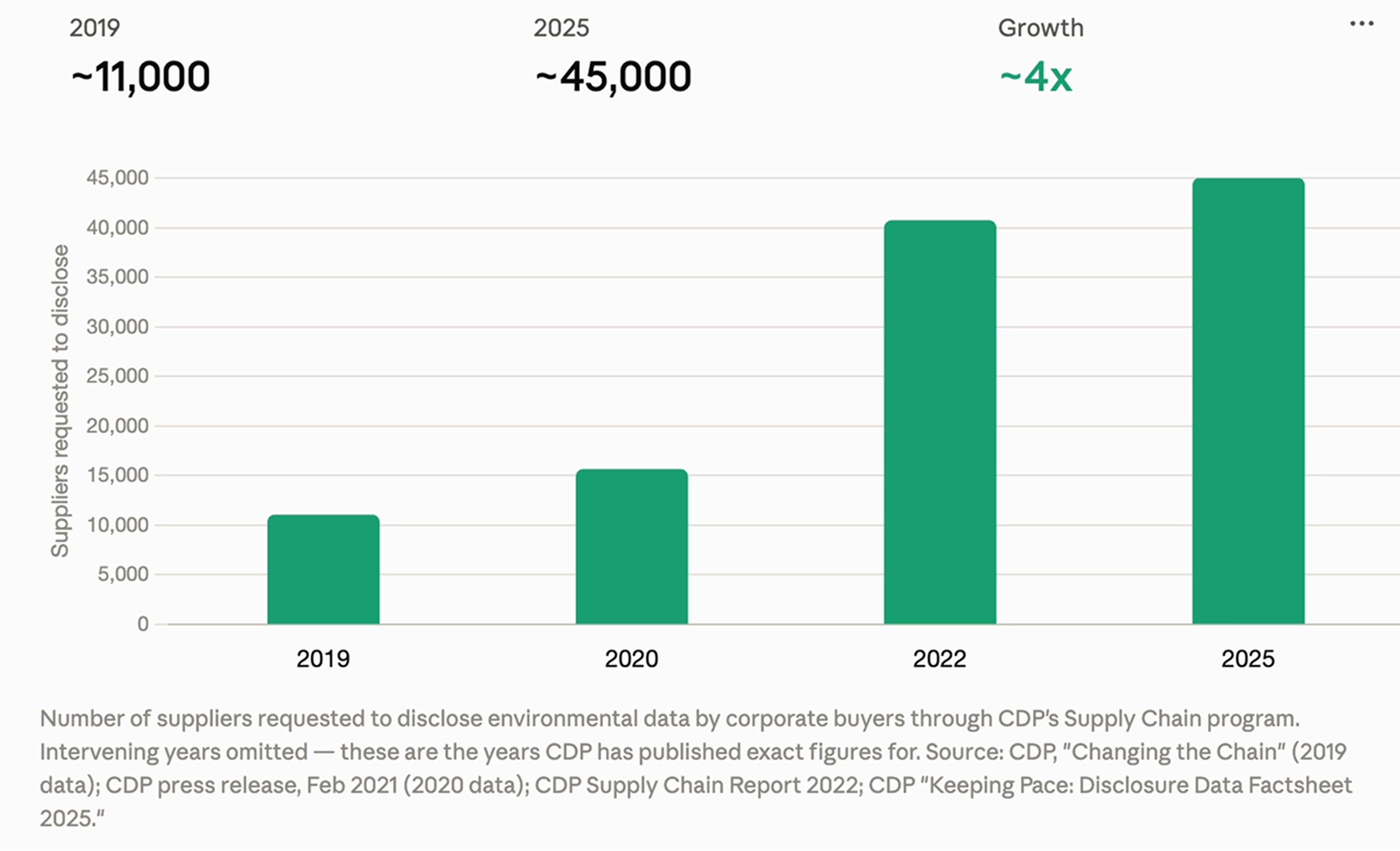
The number of suppliers requested to disclose environmental data by corporate buyers through CDP’s Supply Chain program quadrupled between 2019 and 2025. Sources: CDP data from 2019, 2020, 2022, and 2025.
Where AI saves more than time.
AI is turning months of carbon accounting into hours, but that's just the start. It's putting climate intelligence in the hands of the people who control the biggest sources of emissions—facilities leads, procurement teams, CFOs—so they can make decisions that cut costs and carbon at the same time.
Getting the measurement right matters, though, especially since AI itself uses energy. Watershed's Dr. John Bistline, working with Stanford's Dr. Steve Davis and Tsinghua University’s Dr. Sangwon Suh, published an open framework for measuring AI's own carbon footprint, based on findings that several widely used benchmarks overstate per-query electricity consumption by 4 to 20 times.
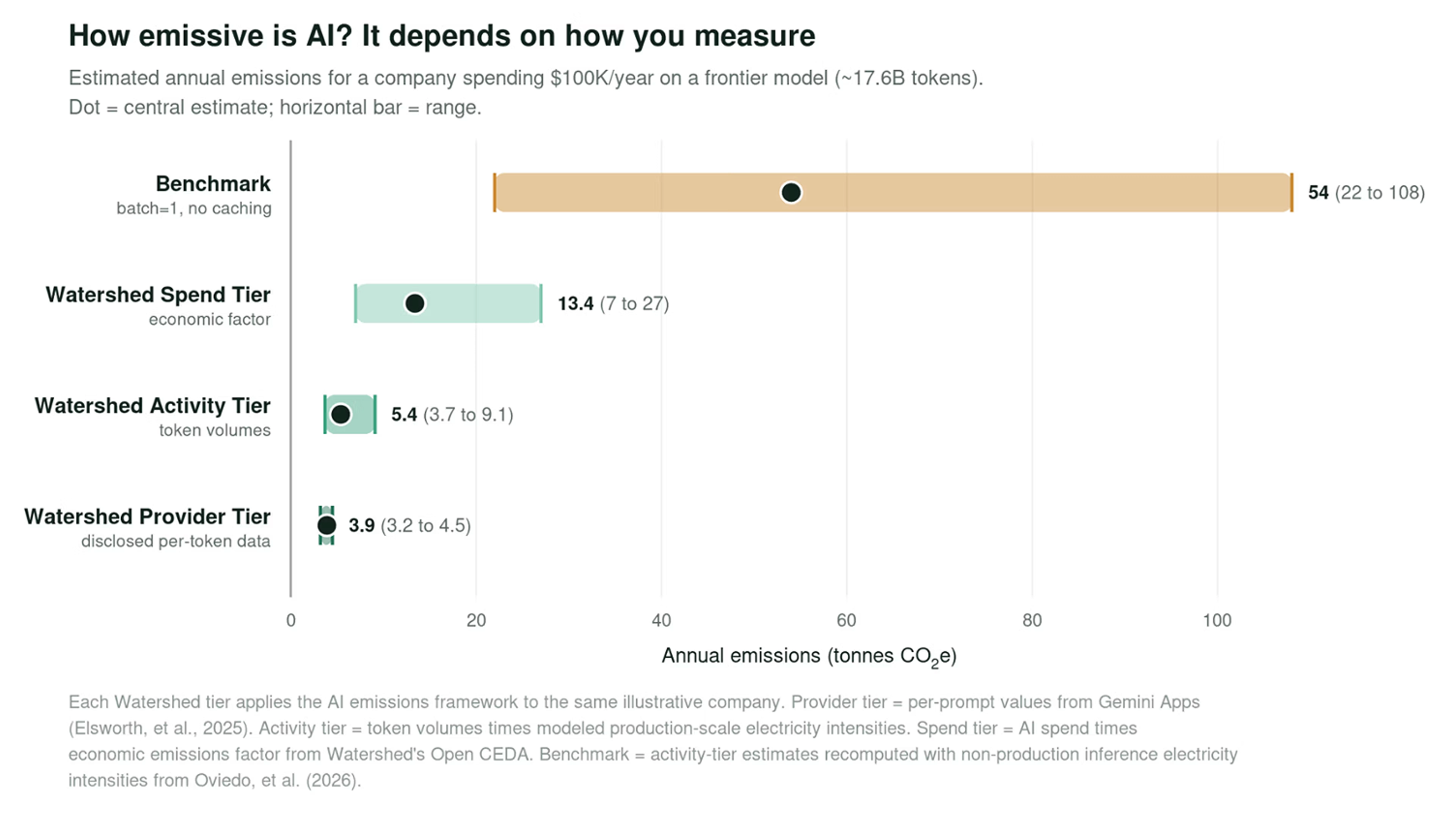
The same AI usage can look dramatically different depending on how it is counted. This chart shows the emissions of a hypothetical company’s AI use estimated using four different measurement approaches: a common benchmark puts those emissions at 54 tCO2e, while our measurement tier drawing on the most granular available data converges toward 3 to 4 tCO2e. The benchmark shows electricity use from standardized tests that measure models on isolated hardware, one request at a time and without the batching and caching that real systems use. Such tests are useful for comparing models, but they can overstate real-world electricity use by 4 to 20 times (Oviedo, et al., 2026).
When applied responsibly—accurately measured and right-sized to the problem, for example—AI can advance climate progress. Burton used Watershed AI to identify a recycled plastic alternative that reduces emissions while also saving more than $130,000. A global manufacturing company analyzed utility spend across its global portfolio, uncovering where it was overpaying for energy and helping prioritize higher-return investments. The sustainability team at Smiths Group uses AI to save an estimated 12 weeks a year on data cleaning, gap filling, and anomaly detection—time the team now uses for decarbonization strategy and energy-efficiency projects.
And it’s early days. In our 2026 survey of 230+ sustainability professionals, fewer than half reported using AI—and most of those were using it for basic data tasks, not strategy. The opportunity to thread sustainability data through procurement, finance, and operations is still largely untapped.
Where more green earns more green.
A new economy is taking shape around the technologies that make energy, materials, transport, and industry cleaner, cheaper, and more competitive. The World Economic Forum and Boston Consulting Group estimate that the global green economy has already surpassed $5 trillion in annual value and could exceed $7 trillion by 2030—which would exceed Germany’s GDP, making it the world’s third-largest economy behind the US and China.
Capital is following the opportunity. Climate-tech venture funding reached $26.1 billion in the first half of 2026, up 55% year over year, with investment flowing into batteries, nuclear, geothermal, carbon removal, and clean-energy infrastructure. Fervo raised $1.9 billion in its IPO, valuing the company at roughly $7.7 billion at pricing and over $10 billion by the end of its first trading day. Nuclear venture funding reached $2.4 billion in 2025. Even frontier technologies such as fusion and direct air capture are attracting hundreds of millions in backing.
The signal is not only how much capital climate technologies can attract. It is also the returns they can generate. In 2025, the S&P Global Clean Energy Transition Index gained 40%, compared with roughly 20% for both the S&P 500 and Nasdaq 100. That one-year performance is not a guarantee, and climate equities remain volatile, but it is a useful reminder that the companies building the clean economy are not simply raising money. In aggregate, investors are beginning to be rewarded for backing them.
The companies that move early are not sacrificing growth for sustainability. They are positioning themselves for the next economy, where clean energy, resilient supply chains, and lower-carbon products are increasingly sources of competitive advantage.
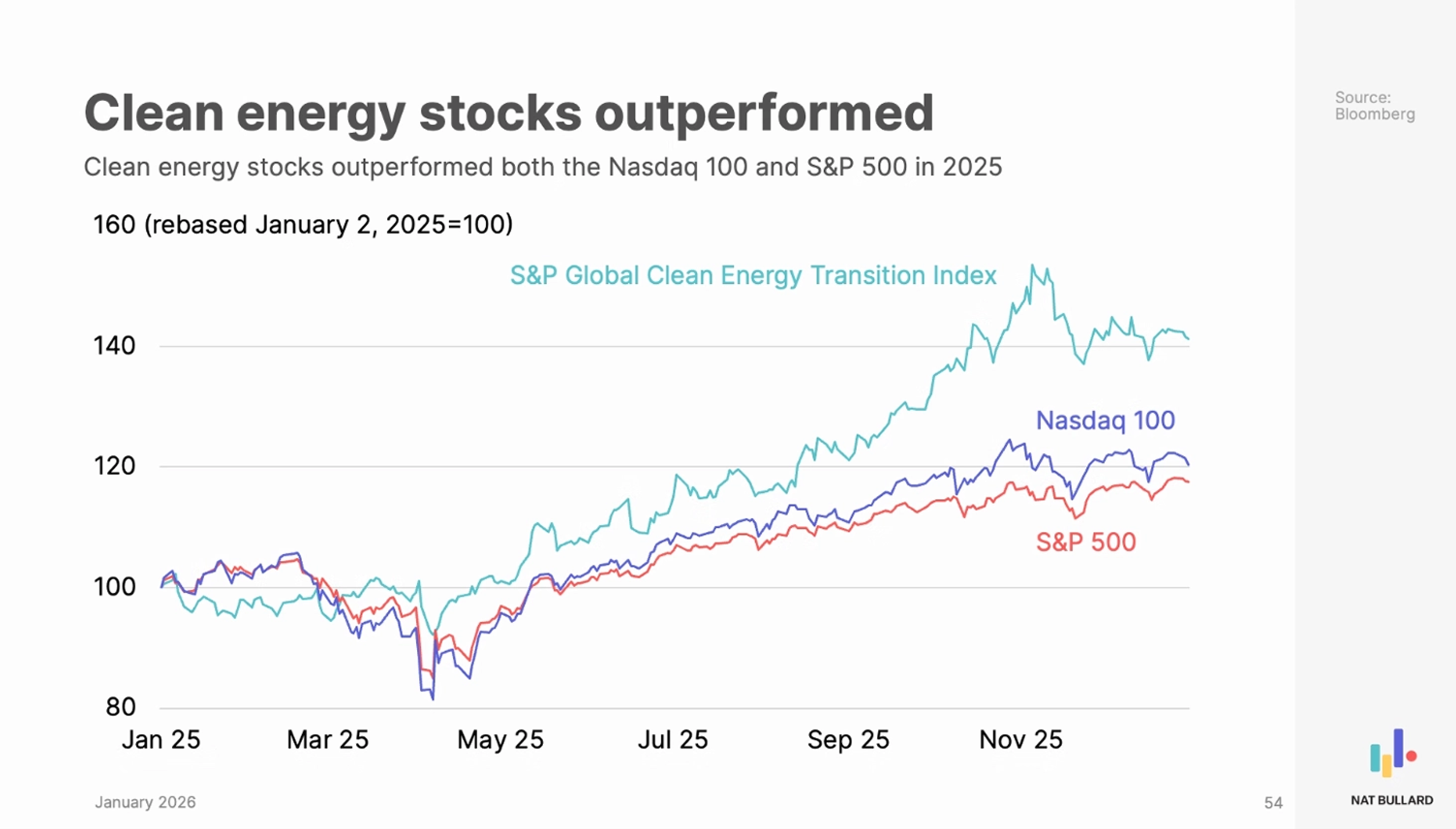
Source: Nat Bullard, Decarbonization 2026 (slide 54); confirmed by Bullard on Latitude Media's Catalyst podcast (Jan 22, 2026): “In calendar year 2025, the S&P Global Clean Energy Transition Index was up 40%—rebased value of a hundred at the start of the year tips out at 140 at the end... more than the S&P and the Nasdaq 100, which are both up about 20% over that same period of time.”
The climate economy is here, but it’s not evenly distributed—and right now, most companies are missing out. They still treat sustainability as a compliance function, disconnected from the teams making daily decisions. They're leaving ROI-positive decarbonization on the table—and falling behind companies that aren’t.
At Watershed, our mission is to accelerate the climate economy. We do that by giving companies the tools to get there. Our customers already manage more than 4.4 gigatonnes of emissions—more than the annual emissions of the entire European Union. Our 2030 goal is to help them collectively cut 500 megatonnes per year. It all starts with treating decarbonization as a business opportunity.
The climate economy is the biggest opportunity of our lifetimes. And it belongs to every company ready to build it.