How we launched an opt-in, sustainability-verified employee swag program that got immediate traction among employees, avoided over-ordering, improved brand consistency, and created a repeatable approach to evaluating the real footprint of apparel choices.
The challenge: Swag demand without the waste
Swag is a cultural accelerator. It helps employees feel like part of a team and drives brand awareness. Because traditional swag programs are often wasteful (all those tote bags and T-shirts piling up in your closet), we avoided company-sanctioned swag for Watershed's first six years.
But the lack of an official swag program led to distributed efforts, which created other problems. Random acts of swag across teams led to uneven quality and inconsistent design standards, and what employees received often depended on team budgets and local decisions, which sometimes undermined cohesion rather than building it. Because orders were decentralized, we lacked a consistent way to quantify and compare impact. At the same time, employee demand kept growing.
Our goal was to create a swag program that employees could opt into and use, while making sustainability a core requirement rather than a marketing claim.
The approach: Build a program with sustainability at its core
We established a limited, opt-in annual distribution program so we could order to demand and minimize leftovers. We designed the program around four principles:
- Sustainability as a non-negotiable requirement We selected a vendor with a credible sustainability track record. We validated claims using our own technology, rather than relying on vendor marketing claims.
- Choose timeless, durable items Although more durable items sometimes have a larger upstream production footprint, we calculated that they were less likely to be discarded or replaced, leading to a lower downstream footprint and less waste. We invested in a small set of high-quality pieces employees would keep and wear.
- Order only what people actually want We used an opt-in model so we could order to demand and avoid over-ordering. For the inaugural February 2026 order, employees could opt into a single-size hat, a sized unisex hoodie, both items, or neither.
- Minimize shipping and complexity We reduced split shipments and unnecessary logistics where possible. We also timed our main order to coincide with our annual sales kickoff event so we could distribute swag at a single location, rather than shipping to many different locations.
The process: Vet broadly, then validate with data
Sustainability adds another dimension to the challenge of finding a vendor that could meet our timeline, budget, branding, and customization needs. We cast a wide net for initial sourcing, relying on general information (such as public sustainability claims) to filter vendors and garments.
We then refined our search, prioritizing vendors that could handle customization (embroidery, screenprinting) in-house to limit the emissions and costs associated with shipping garments from one vendor to another.
We also dug deeper into sustainability implications of the 4-5 garments we were considering. Many vendors offer garments from various manufacturers, each with their own sustainability commitments and practices. And within a given manufacturer’s inventory, different garments have different footprints based on their composition (e.g. organic cotton vs. polyester), production process, and location.
After narrowing down our garment options, we used our own product—Watershed Product Footprints—to measure the product carbon footprint of each garment.
- We built bespoke PCFs of the specific garments we considered buying to understand apples-to-apples how they compared. Using Watershed AI, the PCFs accounted for real-world differences between options, like different fabrics, colors, supplier locations, or supplier processes that our AI could research.
- Using PCFs with consistent methodology, boundaries, and assumptions, we were able to make apples-to-apples comparisons of our options, taking emissions into account alongside cost, shipping, and brand alignment.
- Once we selected a base garment, we edited the PCFs' production graphs (i.e., their decomposed supply chains) to model customization impacts, estimating the incremental emissions from embroidery and screen printing to ensure emissions reflected the finished hoodie employees would receive.
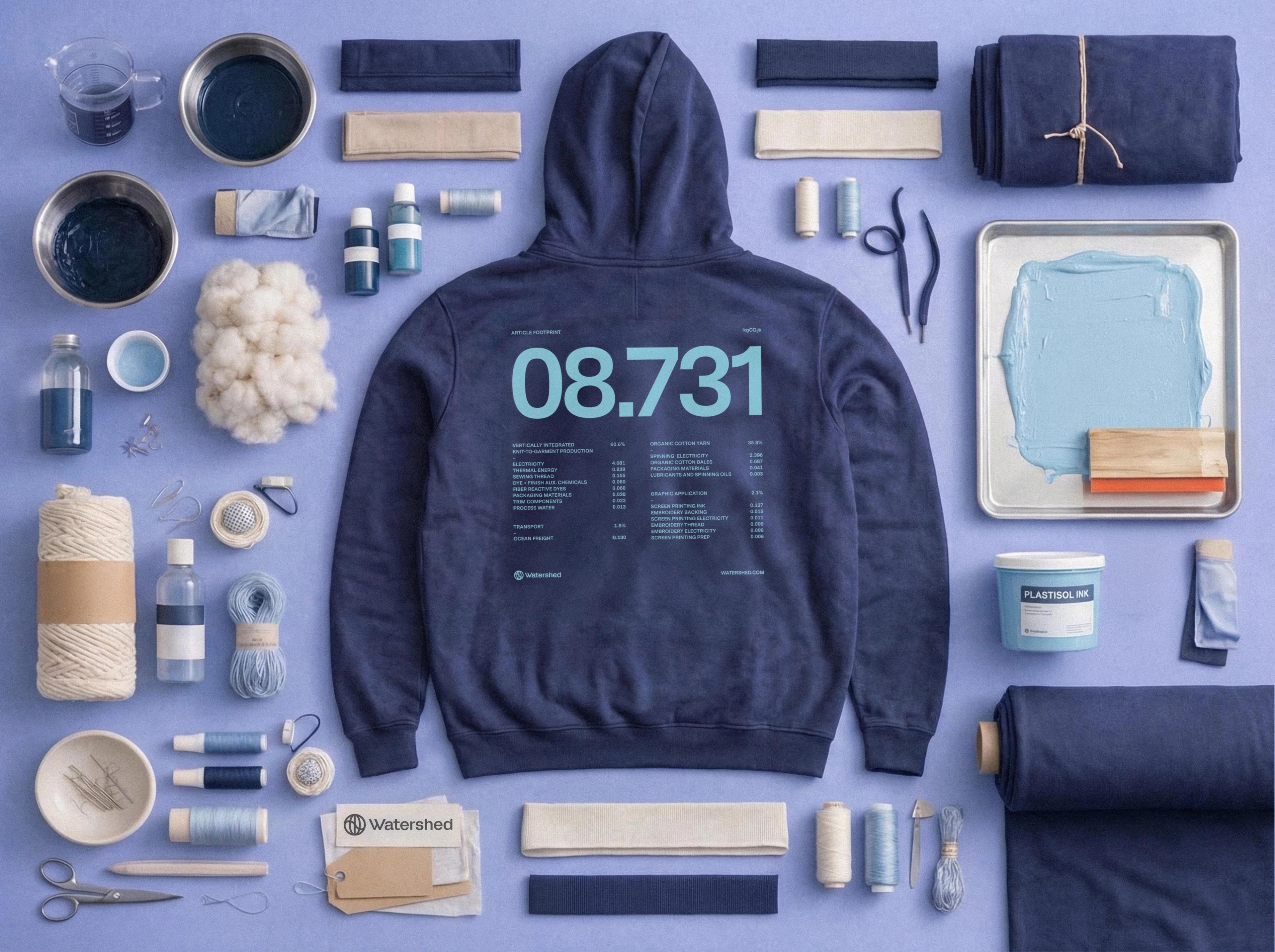
- We translated the results into something employees could see. We used the production graph to draft the emissions callouts that appear on the hoodie design.
The design: Making the footprint—and our mission—visible
We wanted to go beyond simple corporate swag to make articles that are more universally wearable and to convey a message beyond a logo. For the hat, we chose a standard 6-panel with kgCO₂e visibly slashed out, a great conversation starter for anyone who doesn’t know what it stands for.
For the sweatshirt, we kept branding on the front minimal and intentionally designed the back graphic to be bold and make the impact clear. The design includes the measured hoodie footprint (for the selected hoodie and our customization approach) alongside a simple breakdown from our Product Footprints module. The information-dense design on a garment becomes graphic and textural, and communicates our product and mission without being overly branded. We worked through practical design constraints, including rounding, formatting, and layout, so the footprint details could be printed clearly and remain consistent across all sizes.
The result: >80% of employees opted in within one week
The program immediately demonstrated strong internal pull. Within one week, more than 80% of employees signed up (not including those who were on vacation or leave and signed up later).
Employee feedback (Slack, announcement day):


What we learned
1) Small decisions are big decisions
A few product-level choices had outsized impact on emissions. Materials matter: reducing or eliminating polyester made a meaningful difference; organic cotton inputs improved results. Weight also matters: heavier cotton can increase emissions, but durability may extend useful life. Even smaller decisions can have an impact: we found even the choice of color changed footprints, as dark dyes can be more emissive. At the same time, these decisions were less material, so we focused more on weight and fabric.
2) Manufacturing often matters more than the distributor
Some vendors emphasize their own operations, but for apparel, the manufacturing footprint of the garment can dominate the outcome. Evaluating upstream production details matters. For example, where and how an item is manufactured can significantly impact its overall footprint, since electricity emissions depend on the makeup of the power grid in a given country or region. Choosing a vendor who is prioritizing advanced manufacturing and vertical integration where possible improves factory efficiency and reduces unnecessary logistics emissions.
3) For more sustainable sourcing, plan ahead
When balancing sustainability, color matching, timelines, cost, and customization capabilities (including embroidery and screen printing, whether done in-house or outsourced), it’s important to plan ahead. We also ran into a practical “chicken-and-egg” cycle: customization specs depend on garment selection, but vendors often want finalized designs before committing to the garment. This is solvable, but it requires planning for iteration.