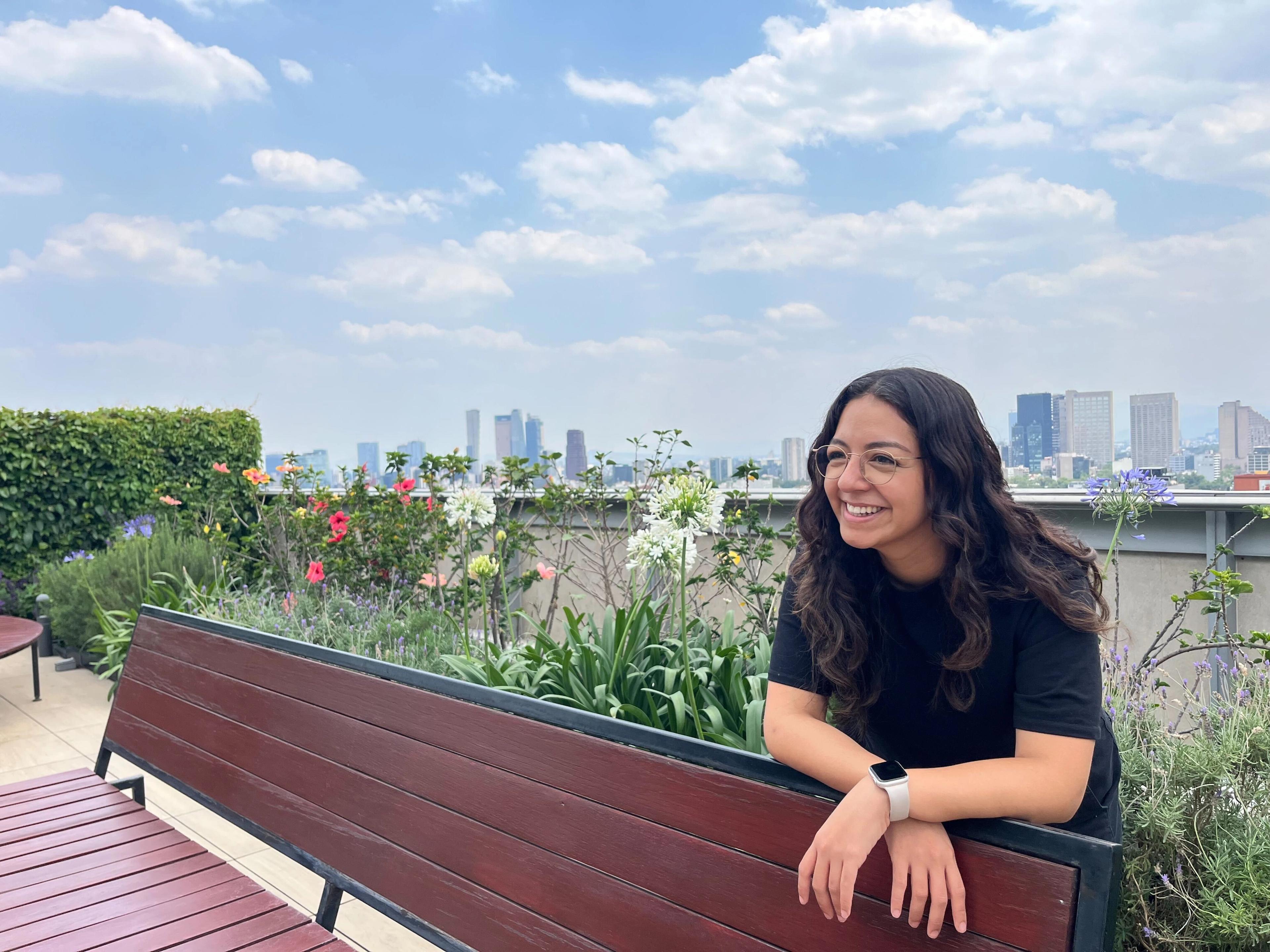
Alicia González is Watershed's Engineering Site Lead in Mexico City, where she's building the team that will own our Supply Chain module (scope 3 emissions). She spent nearly a decade managing engineering teams in Copenhagen—at Zendesk, A.P. Moller-Maersk, and Normative—before making a deliberate decision to move back to Mexico and build something that truly matters.
In this interview, Alicia talks about her path into climate tech, what it actually means to found a team from scratch, and why the Supply Chain problem is one of the most interesting in the industry.
We're hiring on Alicia's team in Mexico City—learn more about our open roles:
- Founding Software Engineer (Mexico City)
- Lead Software Engineer, Product (Mexico City)
- Senior Full-Stack Software Engineer (Mexico City)
What were you working on before you joined Watershed?
Before Watershed, I was at Normative, a Stockholm-based sustainability platform. I was managing their reporting team and value chain engagement team, which is really the equivalent of Watershed's Supply Chain team. I was based in Copenhagen, so I'd take the train up to Stockholm about once a month—a good six hours each way.
You've spent the last several years working on climate-adjacent software—Maersk's internal carbon emissions platform, Normative, and now Watershed. Was that an intentional path?
Very intentional. I worked at Zendesk for almost eight years, and after the pandemic I started thinking seriously about how I wanted to shift toward something that felt more impactful. So I started looking specifically at sustainability and social impact companies, and Maersk’s Energy Transition team was my first step into carbon accounting and climate.
Finding that first opportunity was actually quite difficult, though. There just aren't that many climate-tech companies. I even seriously considered going back to school for a master's degree in environmental science, because I kept asking myself: what is software actually doing for the sustainability movement? Maybe I need to write papers, maybe I need to do something completely different. I feel really lucky that the industry was ramping up right at the moment I was ready for a change.
Do engineers on your team need a climate background?
Definitely not. At the beginning, I thought it was going to matter more than it does. When I first moved into climate, one of the hardest things for me was not having intuition for whether the numbers we were producing were correct. In my past experience in software for customer support, it was easy to know if something worked—you'd used it yourself. But if I ran a carbon calculation and it came back as 100,000 tonnes of CO₂, I had no way to know if that was reasonable or completely off.
What I've realized since then is that once you're actually building, you're hyper-focused on the customer's experience. You may feel the friction of a new domain at the start, and it's hard—but then you build enough of a foundation that it stops being a blocker. What I'm really looking for is curiosity and a willingness to step outside your comfort zone.
What made now the right moment to move back to Mexico?
My husband and I had been thinking about it for a long time. Denmark is a fantastic place—I was there for ten years—but every time I came back to visit Mexico, I could really feel it: the warmth of people who speak my language, who look like me, who share my experiences. I left Mexico at 24, so I'd never actually been an adult here. I really wanted that.
I talked to my therapist about what it would actually take to make the move, and I kept landing on the same answer: it would have to be a climate company, I'd need to be building a team, and it would need to be in Mexico City. A few weeks later I got an email from Watershed's recruiting team. I honestly kept waiting for something to fall apart—it just seemed too good to be true. But things kept aligning, and the timing ended up being perfect in every way.
Now that you're here, what does founding a team actually look like in practice?
A lot of interviewing, a lot of sourcing, and a lot of thoughtful work building out Watershed's hiring process for a new market. One of the things I'm most proud of so far is the work we've done shaping our engineering interview loop for Mexico City. Seeing strong candidates come through and feeling confident that we're finding people who are genuinely a great fit—that's been really meaningful.
And there's something I didn't fully anticipate about this phase: I have real space to think. Every day I'm meeting potential teammates, but I'm also getting to be strategic. When you're trying to set culture from scratch, that time really matters.
Were there other things about Mexico City that surprised you?
Mostly just how warm people are! After ten years in Denmark, I was very used to getting straight to the point. In Mexico City, people speak in a little more flowery, a little more elegant way. A couple of times early on I said something and it came off more blunt than I intended. It's been a fun adjustment.
But the warmth here has been so wonderful. People have been so welcoming—of the office, of me coming back. And the lunch culture is incredible. There's always great food brought in for the team, and I hate thinking about what I'm going to eat, so that's been a genuine quality-of-life improvement every single day.
The Mexico City team owns the Supply Chain module. Can you explain what makes that problem interesting—and what makes it hard?
I'll start with interesting, because I'm genuinely fascinated by it. The supply chain module sits so close to actual decarbonization. A huge portion of a company's emissions often comes from its suppliers—distribution, fuel, transportation. Once you have accurate, specific data on a particular supplier, you can start comparing it to greener alternatives, and that directly affects the company's footprint. To me, that proximity to real-world impact is what makes this work so exciting.
As for what makes it hard—there's quite a bit! One of the biggest challenges is that there are no global unique identifiers for companies. When we try to find emissions data for a supplier—say, a regional logistics vendor—we get back results for their Mexico, Germany, and global subsidiaries, and we have to figure out which one is actually the right match. It sounds like a problem someone would have already solved. They haven't.
Data quality is the other big one. We have a feature that sends surveys to suppliers when we can't find public data, but verifying that the responses are accurate is genuinely hard—and nobody loves filling out a survey, so getting people to respond at all is its own challenge.
I saw a version of this at Maersk too. We had vessel fuel consumption data, which sounds precise, but a lot of it was originally entered by hand on paper forms and then typed into computers—typos, missing entries, all kinds of inconsistencies. We eventually had to acknowledge that mapping real-world fuel usage to perfect accuracy just wasn't achievable. You have to leave a threshold, because real life and the digital representation of real life are never going to be a perfect match. I keep running into variations of that same lesson.
What kind of engineer thrives on your team?
People who have done end-to-end feature development and are curious about the full stack—not necessarily experienced across all of it, but genuinely interested in how the pieces connect. Our module has frontend, backend, and data pipeline components all working together, and engineers who want to follow a thread all the way through, rather than just owning their slice, tend to do really well.
Beyond skills, I'd say people with a strong sense of ownership—being part of the conversation early, helping shape the solution, but also following through all the way to making sure what you shipped is observable and something you actually feel proud of. That full arc is what thriving looks like here.
What's different about working at Watershed compared to places you've led teams before?
So many things! One that struck me early is the approach to hiring. At previous companies I was used to a strong inbound pipeline—people knew the brand, they applied, and we selected. At Watershed the approach is so much more intentional and outbound. There's a real effort to find the people you want and reach out to them directly—which is actually similar to how I got recruited here. That's been new for me and something I've been continuously learning from.
The other thing is rigor. The level of intentionality I see at every layer of Watershed — in documents, in decisions, in how people think through tradeoffs—is something I haven't quite encountered before.
One thing I'll say we're all still learning together is to Stack Rank and Drop. We talk about it constantly as a company principle, and I think we're getting better at it — but people here are so mission-driven that it's genuinely hard to say no to things when you can see the potential impact. I think that's a pretty good problem to have.
Is there something you've worked on in your first two months that you're especially proud of?
Two things! One is the interview loop work—seeing candidates move through a process that evaluates them fairly has been really gratifying.
The other is more technical. I still love building, and the satisfaction of shipping something hasn't gone away. I've been contributing to the Supply Chain module directly, and I recently finished a change that makes exclusion rules (rules that prevent double-counting emissions) more visible when you're looking at your footprint spend—it touches the frontend, the data layer, the pipelines. I'm just waiting on my last PR to be merged, and that one felt really good to get across the finish line.
You spent almost five years mentoring refugees learning to code through HackYourFuture in Denmark. How does that experience show up in how you lead?
The biggest lesson is that there's no better test of your own knowledge than trying to teach something. I joined HackYourFuture when I was still a software engineer, just looking for a volunteering opportunity—I was part of the very first cohort.
What made it so energizing was just being reminded that people are smart everywhere. Give someone the opportunity and the right environment, and they'll run with it. It also changed my career in a way I didn't expect—I came in as an engineer, and the experience of mentoring made me more ambitious about the impact I could have through other people. That was a big part of what drew me toward leadership. I even got to work alongside someone I'd mentored through the program later at Maersk. That was one of the highlights of my career.
You lived in Copenhagen for about ten years before moving back. What do you miss? And what are you definitely not missing?
I definitely do not miss the food—that one is very easy. Mexican food is just on another level.
What I do miss is my friends. Ten years is a long time, and the people I built that chapter of my life with really did see me grow up. My niece and nephew are there too, which is hard. I also miss quiet walks—Copenhagen has about one million people; Mexico City has twenty-two million. You could find pockets there where you were almost completely alone. That kind of stillness is harder to come by here, though the walks in this city are wonderful in a completely different way.
What's your "I could talk about this for twenty minutes" subject outside of work?
Mexican food, for sure—I could go for a very long time on that subject.
And art. Mexico City is such an artistic place, and connecting to that since moving here has been a real gift. Paintings, watercolors, murals, museums—it helps me stay balanced when I spend so much time in front of a screen, and I love that it's all so present here.
If I were in Mexico City for a weekend, what art and food itinerary would you recommend?
I’m still learning the city myself, and there are so many museums I still want to see! But from what I know, on the first day you must go to the Anthropology Museum, and then to the Modern Art Museum, which are a lovely walk from each other. The next, you should visit Zócalo and Bellas Artes to see the murals from the post-revolutionary period.
For food... I'm not ready to make specific recommendations yet. But you can't go wrong with a tuna tostada, and al pastor tacos from anywhere here.
Last question: what Watershed Slack emoji best represents you, and when would you use it?
It's :blob_dance:—I used it just today, after Enrique told me we'd booked a candidate for their next interview round. I love small celebrations in messages. When things are going well, I :blob_dance:.

I also use :meow-finger-guns: a lot as a confirmation.

And I should be upfront: I'm a Slack emojineer. If I can't find the right feeling in the existing catalog, I'll go searching until I find something that works. I've added at least three so far, and I consider it important work.
Alicia's experience reflects what it looks like to build something at Watershed from day one: challenging and meaningful problems, customer empathy, and an inclusive team culture that's being shaped right now.
We're hiring on Alicia's team. If you're based in Mexico City—or thinking about moving there — and you want to work on a problem that sits right at the center of corporate decarbonization, we'd love to hear from you.